Wooden Pegboard Shelf Manufacturer: Custom Designs for Retail Brands
A wooden pegboard shelf system: panel, removable shelves and hooks sold as one programme. Short answer: settle the hole pattern, the panel construction and the mounting hardware before you discuss artwork — those three decide whether it works on a customer’s wall. A pegboard shelf looks like a perforated panel, specified quickly. What decides its […]
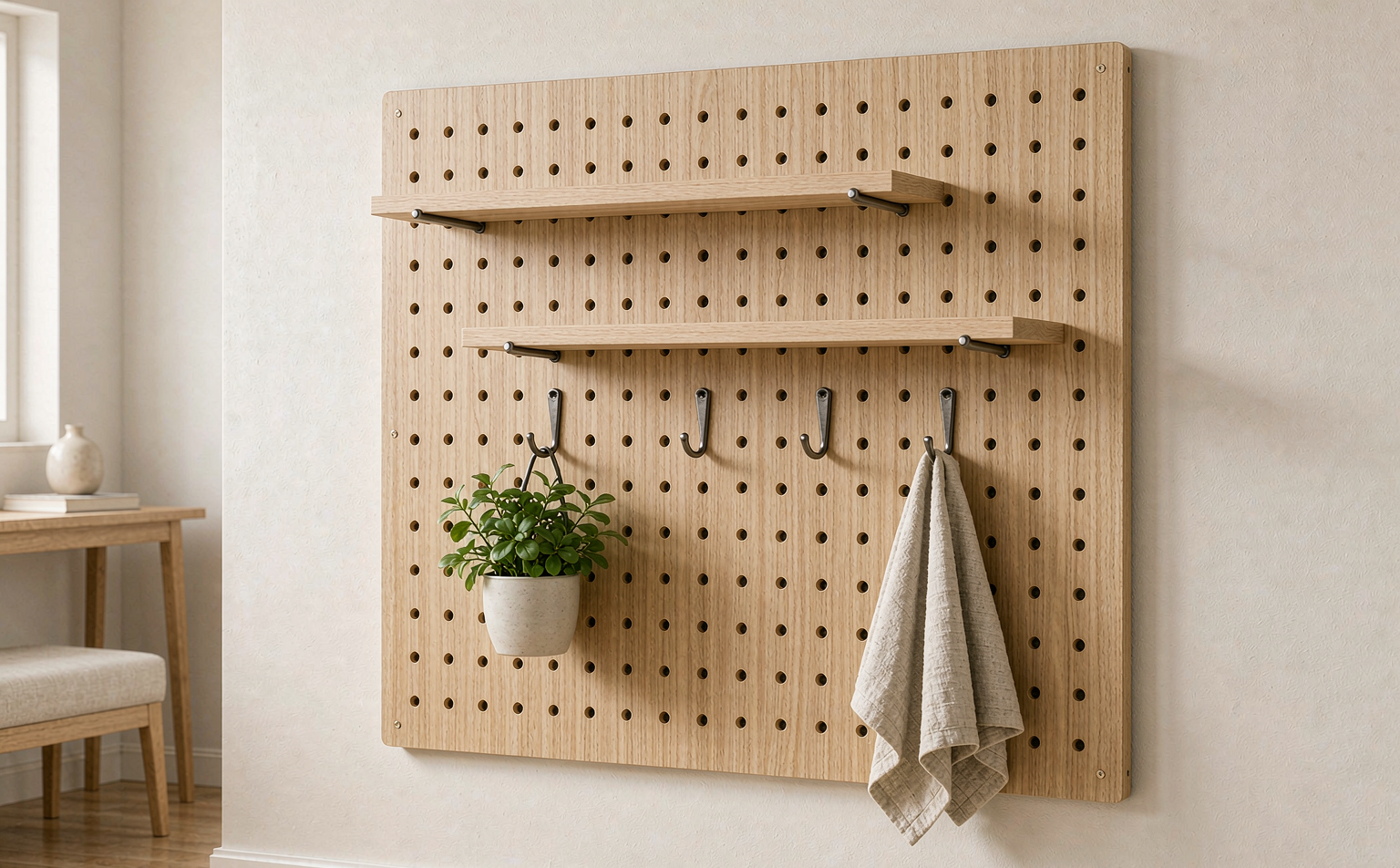
Short answer: settle the hole pattern, the panel construction and the mounting hardware before you discuss artwork — those three decide whether it works on a customer’s wall.
A pegboard shelf looks like a perforated panel, specified quickly. What decides its fate is geometry the shopper never reads: hole diameter, grid spacing, panel thickness, stand-off from the wall, and whether the hooks still grip after months. Brands get this wrong in a specific way — the sample looks right on a bench, then the first review mentions a sagging shelf or a hook that pulls out.
What a wooden pegboard shelf is
A perforated wood panel that mounts to a wall and carries removable accessories — pegs, hooks, small shelves, trays or baskets. The holes are the interface, so it is a system rather than a panel: if they don’t match the accessories a shopper already owns, the product is stranded.
Pick the panel construction first
Plywood is the usual choice for a panel that must stay flat: cross-laminated layers resist the cupping a wide solid board develops as humidity changes, and a good face veneer takes a clear finish well. The exposed edge is veneered, edge-banded, or deliberately left as a visible ply line — a design decision worth making on purpose.
Solid wood gives the heaviest, most furniture-like result and the warmest edge, but a wide solid panel is the most likely to move; it suits smaller panels, slatted designs and premium positioning. MDF machines cheaply but is heavy, weak at holding threads in the edge, and poorly suited to a humid room — fine painted, a poor choice when the selling point is real wood.
Wood choice trades cost against grain character and stability, covered in this guide to choosing wood materials for custom products. For a pegboard, stability outranks appearance: a cupped panel is a return.
Thickness is a load decision, not a look decision
Thickness controls how much the panel flexes between fixings and how much material a hook has to bite into. A thin panel spanning a wide wall bows, and holes in a thin panel elongate under repeated loading — the mechanism behind hooks working slowly loose.
Discuss thickness together with span: a backing rail or mid-span support changes what is sufficient, so ask what span the quoted thickness was designed for.
Hole geometry: the decision that locks your accessory ecosystem
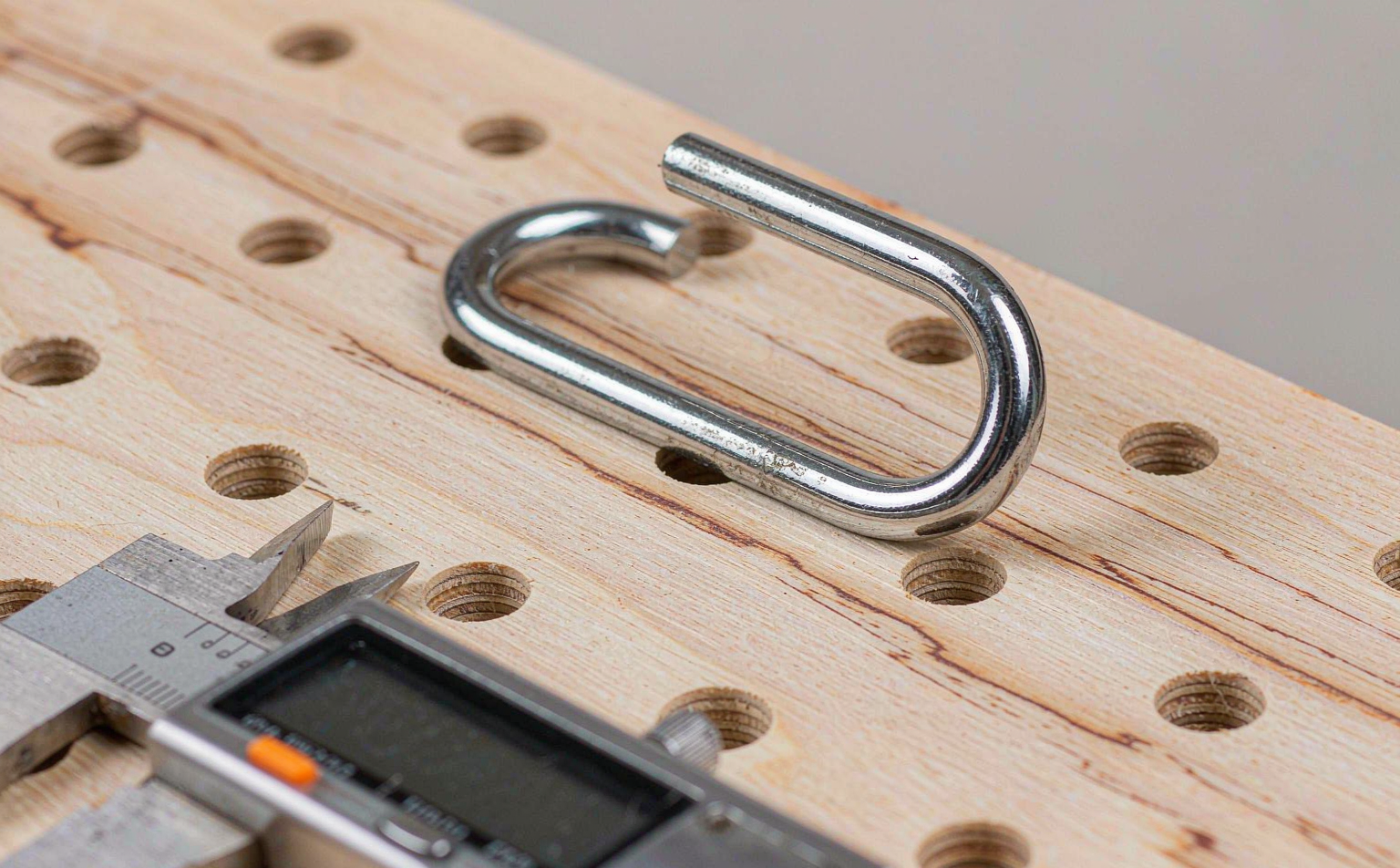
Two conventions exist. The North American hardware convention uses 1/4-inch holes on 1-inch centres, the pattern most mass-market hooks are made for. A metric convention uses roughly 5–6 mm holes on 25 mm centres, common on European and some Asian accessory lines. Decorative peg walls are a third thing: larger pegs, spaced several inches apart in a deliberately sparse grid.
The choice has nothing to do with manufacturing difficulty and everything to do with what your customer will hang on it. The 1/4-inch pattern opens an accessory market the shopper can walk into; a decorative pattern means you control the accessory sale and should plan to sell pegs in the box.
Whichever you pick, write down hole diameter with tolerance, centre-to-centre spacing, edge distance at the panel border, and whether holes are through or stopped. Then test with the actual accessory, not a drawing.
Example Conversation — hole compatibility
Buyer: “We want the standard hole size so customers can use hooks they already have.”
Supplier: “Then we need the hooks before we finalise the drawing. We can hold 6.35 mm on 25.4 mm centres, but fit depends on the hook’s wire diameter and how its bend engages the back of the panel. Send two or three of the hooks you want it to work with and we will drill test panels to those.”
This cannot be settled on paper because of tolerance stacking: a hole at the top of its tolerance with a hook at the bottom of its own gives a loose fit — and that is what shoppers describe as the hook falling out. Fit is physical, so verify it on physical parts.
Registration across panels
For a modular range the grid must line up across every size, which needs a common origin point rather than a grid centred on each panel. Per-panel centring looks fine alone and misaligns the moment two panels hang side by side.
Load, sag and the hardware you ship
Most pegboard disappointment is structural: a panel fastened only at its corners bows in the middle, brackets too far apart let the shelf flex, and hooks pull out because the hole has elongated.
Three items address this: thickness relative to span, fixings, and the stand-off. A pegboard needs a gap behind it — batten, spacer or cleat — so pegs pass fully through and seat; a panel screwed flat to the wall leaves the hook nowhere to go.
Example Conversation — load rating
Buyer: “What weight can the shelf hold?”
Supplier: “We can specify the panel and bracket, but one figure depends on what is behind it. Into studs on two battens, a shelf like this carries everyday kitchen items comfortably. Into drywall on anchors alone, the failure is usually the wall fixing, not the panel. Tell us the market and we will specify hardware and instructions for that wall type.”
That answer is worth more than a number, because the wall is part of the system: stud-and-plasterboard markets need hardware and instructions written for them, brick-wall markets need different fixings. Ask which wall type the instructions assume and whether hardware is in the carton.
Finish, edges and moisture
Every hole is raw edge, so a perforated panel has far more exposed surface than a solid one. Sealing those edges keeps it stable in a kitchen or bathroom; panels finished on the face with holes cut afterwards are the ones that swell.
Agree the moisture target before production and read it on packed pieces, not on a board at the start of the week; interior wooden products are commonly dried to roughly 8–12%. See controlling wood moisture in custom wooden products and why wooden products crack or warp.
Finish follows use: a hard-wearing clear coat for a kitchen panel, paint for a branded colourway, oil or wax where the brief is natural. For a panel carrying food-contact items, the finish specification and its documentation matter more than the colour.
Flat-pack versus assembled
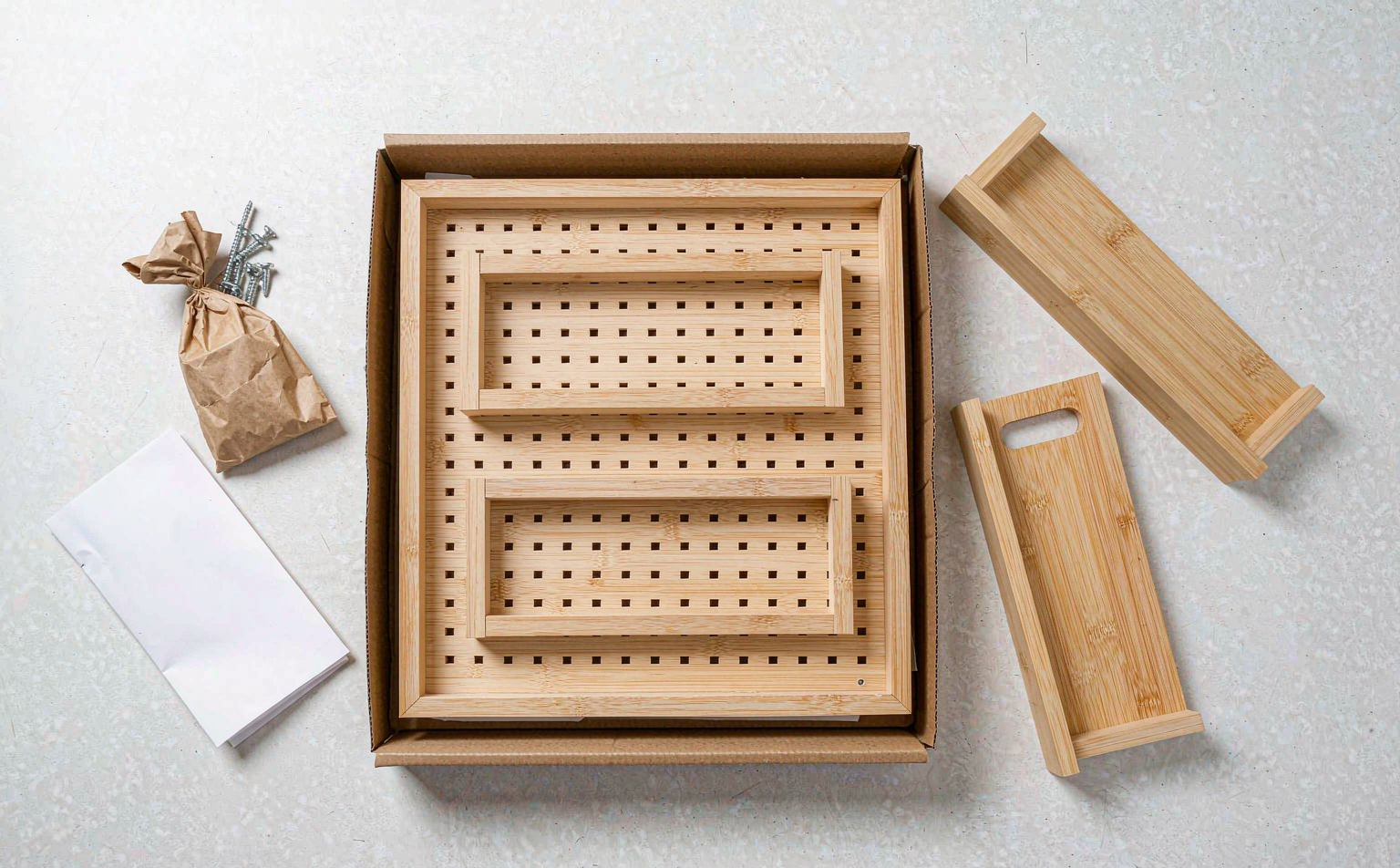
A pegboard is bulky and thin: expensive to ship as air, easy to damage at a corner. Flat-pack is usually right — panel and shelves flat, accessories pouched, hardware bagged.
The risk is not the panel but the small parts: missing screws and miscounted hooks cost more per incident than a damaged panel. Specify hardware as a counted sealed pouch and make the packing list part of the inspection — see wooden product packaging for importers.
MOQ, tooling and where cost goes
MOQ is driven less by the panel than by what is unique about it. A stock size with a standard grid carries a lower minimum; a custom size, non-standard grid, bespoke hook or branded shelf profile each adds setup — a drilling programme, a jig, tooling for a metal part.
Example Conversation — MOQ on a custom size
Buyer: “Can we do 300 of a size that isn’t in your catalogue?”
Supplier: “Yes, and the drilling programme costs the same either way. The extra cost is material yield: a non-standard size wastes more of each sheet, so unit price rises. If you can accept a size that nests efficiently on a standard sheet, both the minimum and the price come down.”
Nesting is the cost lever most buyers never ask about: sizes that cut efficiently from a standard sheet cost less per unit than sizes leaving unusable offcuts, and the saving often exceeds the difference between two wood species.
Logo treatment follows the same logic as elsewhere: engraving suits a natural finish, printing suits a colour mark and needs an adhesion check on the bulk run — see logo QC on bulk engraved runs.
From sample to bulk: what to approve
Approve the sample as a specification: measure hole diameter at several points, check the grid against the drawing, fit the real hook and pull on it, and mount the panel on a wall rather than judging it on a bench.
Example Conversation — sample to bulk consistency
Buyer: “The sample hooks fit tightly. How do we know the bulk order will?”
Supplier: “We fix the drill programme and bit replacement schedule for the run, and check hole diameter at intervals rather than only at the start. Bits wear, and that is where drift comes from — so the control is a scheduled check, not a first-piece one. We can add hole gauging to the inspection points so you get the readings.”
Tool wear is the honest reason bulk differs from sample on a perforated product, and it is controllable: put the check in the inspection plan. See approving wooden product samples and the importer quality control checklist.
Frequently asked questions
What hole size should a retail wooden pegboard use?
Match it to the accessories your customer will use: 1/4-inch holes on 1-inch centres fit the widest range of mass-market hooks, 5–6 mm on 25 mm centres fit another family, and large decorative pegs suit a styling-led product. Write diameter and tolerance into the specification.
How thick should the panel be?
It depends on span and load: thickness resists bending between fixings and hole elongation under repeated loading. Ask what span a quoted thickness was designed for.
Does the panel need a gap behind it?
Yes — pegs and hooks need somewhere for their ends to go, so a batten, spacer or cleat is part of the system, not an optional extra.
Can we mix panel sizes in one order?
Usually, if they share wood, finish, thickness and hole grid — the constraint is material yield, not the panel count. Confirm whether the MOQ applies per size or across the order.
Can we use our own hooks and accessories?
Often yes, and worth doing if you already sell an accessory range. Send physical samples before production so hole fit can be tested; a drawing cannot show the loose fit that makes hooks pull out.
To scope a wooden pegboard programme, send an inquiry to woodhomeware.com with panel size, thickness, wood preference, hole pattern and the accessories it must fit, mounting format, finish, packing format, quantity and destination market. Starting points include the midcentury wall pegboard shelf, the solid wood pegboard display shelf, the modular pegboard hook rack, the wall pegboard room divider and the wall key and tool storage rack. Cao County Qingtan Muyu Crafts Co., Ltd, also known as Cao County Qingtan Muyu Crafts Co., Ltd, produces wooden homeware, storage, décor and furniture for importers, wholesalers and private-label brands.