
How to Control Wood Moisture in Custom Wooden Products
A B2B guide to controlling wood moisture through defined meter checks, material records, conditioning, design, sample approval and export packing.

Moisture control is not a single number written on a purchase order. For a custom wooden product, it is a chain of decisions: the wood selected, the way it is stored, when it is measured, what happens after machining, how the product is designed to move, and how it is protected before shipment. If one part of that chain is vague, a buyer can still receive a product that looked acceptable at the factory but changes after delivery.
This guide is for importers, retail brands, wholesalers and OEM buyers sourcing custom wooden products. It turns a general request about wood moisture content into practical supplier questions and approval points. Search language such as wood moisture meter, wood drying, wood moisture content and wood warping points to real concerns, but a sourcing plan must go beyond a meter reading.
Quick answer: how do buyers control wood moisture in custom products?
Start by defining the product, wood construction and intended destination conditions. Ask the supplier how material is received, stored, conditioned, measured and released to production. Agree the measurement method, the points to be checked, the stage of production, the sample record and what happens when material is outside the agreed requirement. Then make sure the design, machining sequence, finishing and packaging are appropriate for the product—not just for an individual board.
A moisture reading is evidence at one moment, not a lifetime guarantee. Wood can gain or lose moisture in service. The aim is not to promise that wood will never move, but to reduce avoidable risk through suitable material, construction and clear records from sample through bulk production.
Why a single moisture target is not enough
It is tempting to ask a factory for one universal percentage. That is incomplete without the wood species or panel type, component thickness, construction, finish, storage environment and final market. A thin drawer divider, a wide solid-wood panel, a framed product and plywood do not react in the same way.
Ask the supplier to explain the product-specific plan. Which components are solid wood, finger-jointed stock, plywood, bamboo panel or another construction? Which are wide, thin, long, cross-grain or tightly fitted to another component? Which surfaces will be finished, and will the product travel through a different climate? Those answers make the discussion concrete.
For a material comparison before the RFQ stage, see our guide to wood materials for custom products. The material route should be confirmed in the specification, not inferred from a generic product photograph or a broad label such as “solid wood.”
Write a moisture-control requirement that can be checked
A buyer does not need to prescribe the entire drying process. They do need a concise record that says what will be checked and how a decision will be made. It can cover:
- Material identity: the species, panel construction or other agreed material for each relevant component.
- Product context: the component’s thickness, grain direction, use and intended destination or customer environment.
- Measurement protocol: meter type or agreed method, material setting where applicable, measurement locations and timing.
- Sampling record: which lot or components were checked, the reading record and who reviewed it.
- Disposition: how material outside the agreed range is held, reconditioned, rejected or otherwise handled before use.
Ask for a defined check rather than “moisture controlled.” The latter is a claim; the former can be reviewed. It also prevents confusion over whether the supplier measured incoming lumber, rough-cut pieces, finished components or one convenient board.
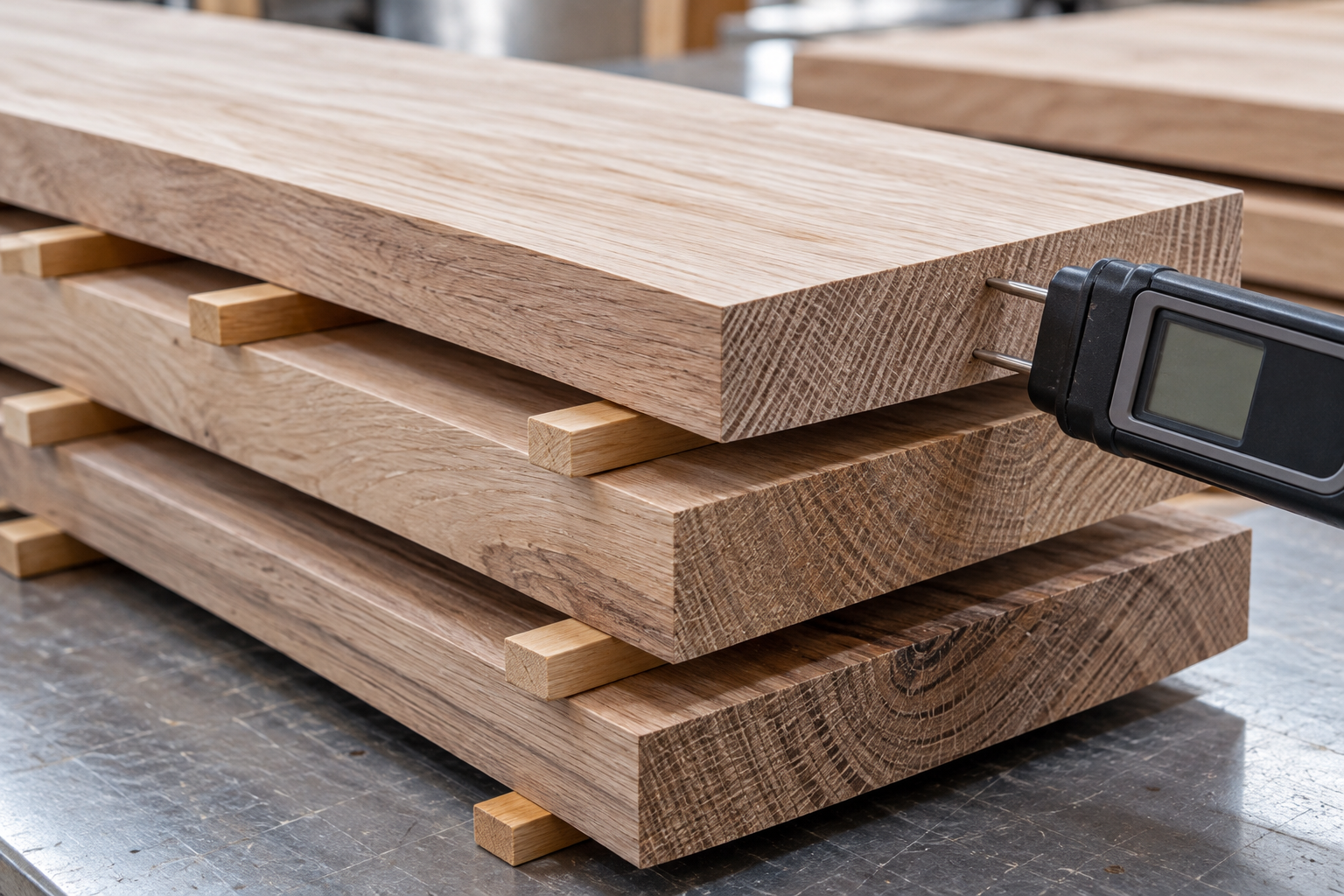
Use a wood moisture meter as part of a process
A wood moisture meter is useful only when the reading is interpreted in context. Ask what instrument or method is used, how the material setting is selected, where readings are taken and whether the record identifies the inspected lot. One exposed face may not tell the same story as another area or a newly machined component.
Do not ask for a lone meter-display photograph as proof of stability. Request a simple record tied to the material lot and product stage: component, measurement date, check locations, observed range and release decision. The buyer needs a record comparable with the approved product plan.
Separate whether material was prepared before machining from whether the finished construction allows normal movement after delivery. A meter supports the first question. Component design, joint choice, grain orientation and finish strategy matter to the second.
Control the handoff from material to machining
Wood can change after cutting, planing or routing exposes surfaces and releases internal stresses. A factory may need to hold or condition rough components before final sizing, depending on product and material. Do not dictate a generic waiting time; ask where movement may show up and how critical pieces are checked before assembly.
Give special attention to pieces where small movement creates a visible functional problem: a lidded storage box, flat tray, drawer front, door, frame opening, long shelf or fitted insert. Mark critical dimensions and interfaces. “No warping” is too broad to inspect; a lid that sits and opens as the approved sample is a functional reference.
A clear RFQ should also identify the intended final use and destination. That helps the manufacturer decide which construction details require closer review before a sample is released.
Design for normal wood movement
Moisture management does not end at the factory floor. A stable product combines material preparation with a design that does not restrain wood unnecessarily. Wide solid components, cross-grain attachments, thin panels and one-sided construction details deserve an engineering discussion.
Ask how the construction accommodates expected change: grain direction, panel build, clearance at a lid or insert, joint selection, hardware position, edge treatment or component support. The answer should relate to the actual SKU, not generic reassurance.
Finish helps protect appearance and can slow the rate at which a surface exchanges moisture, but it is not a substitute for material preparation or sound construction. If the inside and outside of a product receive different treatments, discuss that choice with the supplier and review it on the production-representative sample. Do not turn a coating description into a promise that the product cannot change in service.
Approve the sample and bulk process together
Retain a final approved sample and connect it to the technical record: material construction, finish, artwork where relevant, critical dimensions, functional checks, moisture-control plan and packing method. The sample is the visual and functional reference; the record explains how it will be reproduced.
Before bulk release, ask whether material source, construction, finish, thickness, joint method, hardware or package changed. A change may require a new review, particularly for tight lids, panels, flat surfaces or other fit-sensitive parts.
Include storage and packaging in the plan
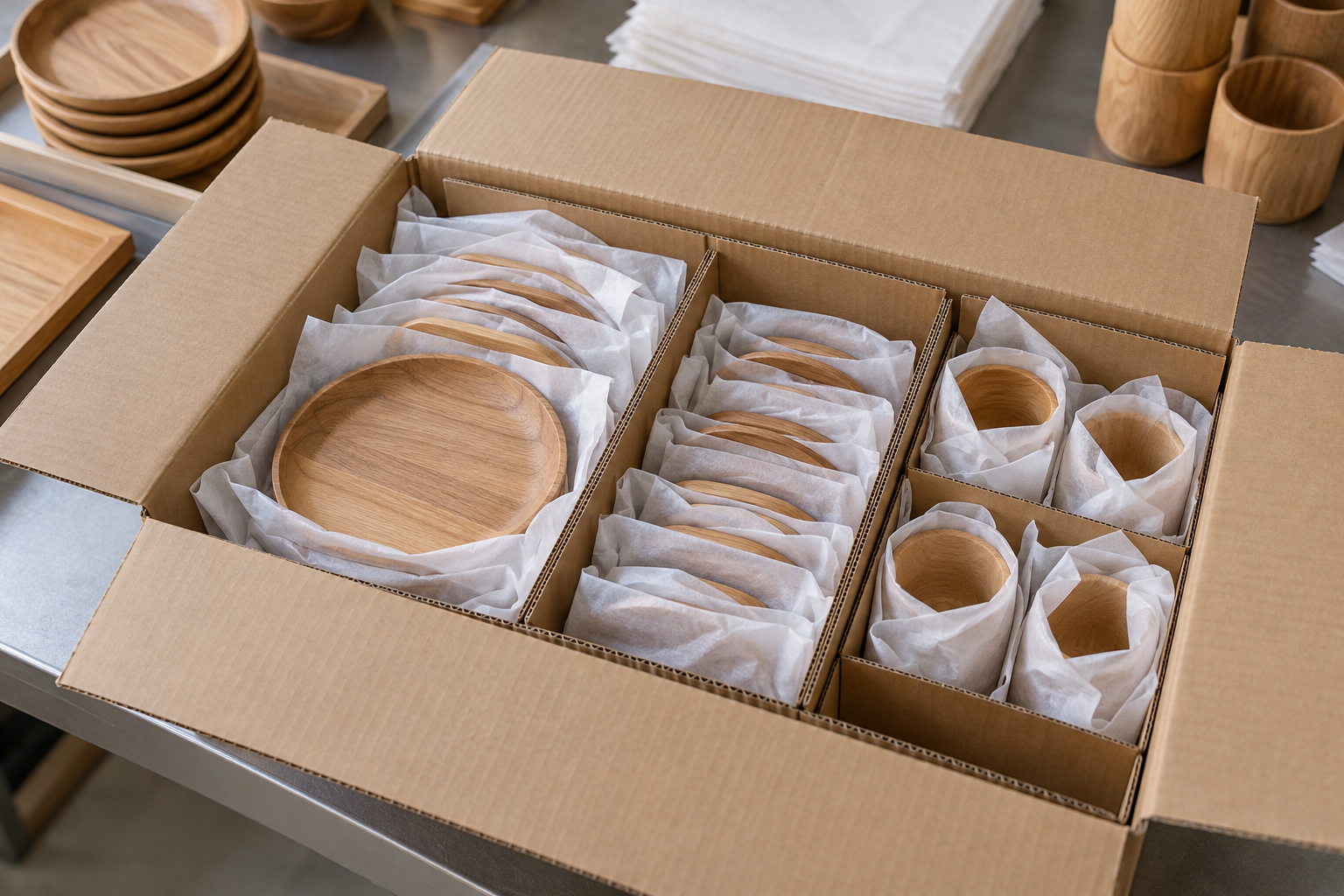
Finished wood products can sit in a factory, warehouse or container before reaching the buyer. Product protection should prevent units from rubbing, shifting or being held in a way that damages edges or applies pressure to sensitive parts. The pack-out should also be reviewed in relation to the expected shipping route and storage conditions.
Discuss how finished products are stored before packing, how units are separated, what protects finished faces and how carton fit prevents movement. Do not assume that packaging is only an aesthetic decision. It affects whether the approved condition can be maintained through handling and receiving. Our wooden product packaging guide provides a broader export-pack review.
Pre-shipment checklist for moisture-related risk
| Check area | Buyer question | Useful evidence |
|---|---|---|
| Material | Is the agreed construction used for each relevant component? | Approved specification and incoming-material record. |
| Measurement | Was a defined lot checked at the agreed stage and locations? | Moisture-control record tied to the lot or production stage. |
| Function | Do lids, panels, drawers, frames or flat bases work like the approved sample? | Sample comparison and functional inspection notes. |
| Finish | Are the agreed surfaces consistently finished and free of obvious defects? | Finished-product inspection against the approved reference. |
| Pack-out | Are units supported, separated and protected for the agreed route? | Packed sample or pre-shipment carton check. |
Use these checks with a broader wooden product quality-control checklist. The point is to catch an identifiable mismatch before shipment, not to create a general promise against every future environmental change.
Buyer checklist
- Define the wood construction and the destination use for the proposed product.
- Identify wide, thin, cross-grain and close-fitting components in the drawing.
- Agree what a moisture-control record must identify: lot, stage, measurement points and release decision.
- Ask how raw material and rough components are stored and conditioned before final work.
- Review lid, panel, drawer, frame or flat-base function on the production-representative sample.
- Approve finish coverage and the relationship between visible and internal surfaces.
- Require notice of material, construction or process changes after sample approval.
- Check finished goods and cartons against the approved sample and written record before shipment.
FAQ
What is the best wood moisture content for custom wooden products?
There is no single figure that is appropriate for every product. The agreed requirement should take account of the material, component thickness, construction, intended destination and use. Define a product-specific measurement and release plan with the supplier rather than relying on a universal number.
Should importers ask the supplier to use a wood moisture meter?
Yes, when the project needs moisture checks, but request more than a photograph of a display. Agree what is measured, when it is measured, where readings are taken, which material lot is represented and how the result is recorded.
Can kiln-dried wood still warp after shipment?
Wood can still exchange moisture with its environment. Risk control therefore combines material preparation with construction that accommodates normal movement, approved functional samples, balanced finishing decisions and suitable storage and packaging.
How do I prevent wood warping in a custom product order?
Define the material and destination context, review the product design for fit-sensitive or wide components, agree the moisture-control process, approve a representative sample and inspect bulk goods against the same record. Do not rely on a generic “no warp” statement.
What should a moisture-control record include?
It should identify the relevant material or lot, product stage, agreed measurement method, check locations, results or observed range and the decision to release, hold or otherwise handle the material.
Make the request specific enough to manage
Cao County Qingtan Muyu Crafts Co., Ltd, Cao County Qingtan Muyu Crafts Co., Ltd, works with B2B buyers on custom wooden products where material, construction, finishing and export pack-out need to be defined together. If a product has wide panels, fitted parts, lids, drawers or another moisture-sensitive detail, send the drawing, intended market and expected use with the inquiry. A clear brief gives the supplier something practical to sample and the buyer something practical to inspect.