How to Choose a Wooden Kitchenware Supplier in China
A practical B2B guide to choosing a wooden kitchenware supplier in China, from SKU scope and samples to QC and export packaging.
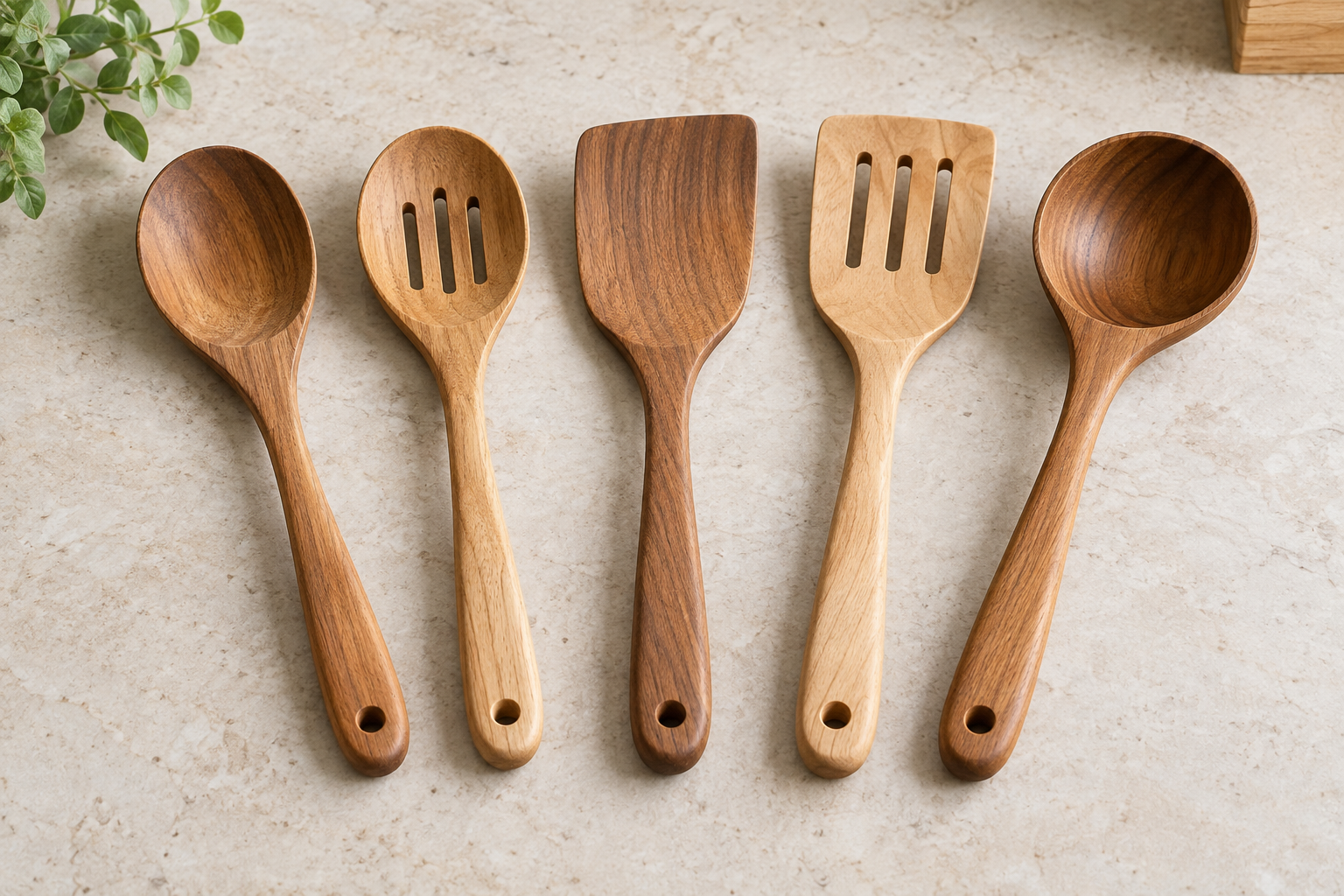
Choosing a wooden kitchenware supplier in China is not mainly about finding the lowest catalogue price for a spoon or spatula. The useful question is whether the supplier can turn your product brief into a repeatable range: the right materials for each SKU, a clear food-contact discussion, consistent finish and logo treatment, controlled packaging, and a sample that can be used as a bulk reference.
Quick answer
Start by defining the kitchenware range and its selling format. Shortlist suppliers based on evidence related to those exact products, not a broad “wooden products” claim. Request a comparable quotation, approve a representative sample set, document every material, finish, logo and packaging decision, then inspect the finished range and its cartons before shipment.
What counts as wooden kitchenware?
For a sourcing project, wooden kitchenware may include cooking spoons, spatulas, turners, ladles, utensil sets, scoops, rolling pins, cutting boards, serving boards, trays and small kitchen organizers. They share a material family, but they do not have the same manufacturing or buying risks. A flat turner needs a practical edge shape and a comfortable handle. A board needs a different conversation about construction and flatness. A set adds component control, presentation and missing-piece risk.
This is why an importer should not ask only, “Can you make wooden kitchenware?” Start with the SKUs that matter to the range and ask the supplier to explain its proposed material, manufacturing method, finish and pack-out for each. Cao County Qingtan Muyu Crafts Co., Ltd uses this product-by-product approach when reviewing custom wooden product enquiries.
1. Build a range brief before comparing suppliers
A clear brief creates comparable quotations and makes supplier screening faster. It does not need to be a final technical drawing on day one. It does need to describe the commercial product rather than a mood board alone.
- List each SKU, its intended kitchen task and whether it is sold alone or in a set.
- Give target dimensions, silhouettes, handle shape and any functional feature such as a hanging hole, slot or groove.
- State the preferred wood or material direction, finish appearance and acceptable natural variation.
- Identify every non-wood component: silicone head, metal ring, textile tie, paper insert, stand or care card.
- Provide the logo artwork, its intended placement and the retail-label information.
- Describe whether the range needs plain export cartons, individual retail boxes, a gift set or a mixed-SKU carton.
- Tell the supplier the destination market and which food-contact, labeling or testing requirements the buyer needs addressed.
Use one controlled version of this brief when you request quotations. If the wood, logo method or packaging changes, record the revision against the relevant SKU. The custom wood product RFQ checklist helps buyers collect that information before comparison begins.
2. Screen for relevant capability, not generic capacity
A supplier may make attractive decorative wooden items without being the right partner for a kitchenware range. Ask for evidence connected to your own product types. For cooking utensils, discuss the head shape, handle transition, hanging feature, sanding and finishing approach. For a multi-piece set, ask how components are identified, packed and checked. For a board or tray, ask about the specific construction and surface expectations that apply to that SKU.
Supplier verification should cover company identity, product-relevant experience and communication quality. A live discussion, current material or sample images, a walkthrough of the proposed build and a written response to your range brief are more useful together than a catalogue of unrelated items. You are testing whether the supplier can translate a request into manufacturing decisions without filling gaps by assumption.
For a preliminary product overview, see the Cao County Qingtan Muyu Crafts Co., Ltd product categories. A sourcing decision should still be based on the specific project, sample and commercial terms being discussed.
3. Make materials and finish decisions SKU-specific
Wood is not a single procurement specification. A spoon, a board and a tray may each need a different material discussion because their functions, profiles and visual priorities differ. Ask the supplier to name the proposed wood or material, explain how visible variation will be handled, and identify the finish system proposed for the item.
Where an item will touch food, make the food-contact discussion explicit. Ask what coating, oil or other treatment is proposed; which faces and edges receive it; what care information will accompany the product; and what documentation the supplier can provide for the buyer’s destination-market compliance process. Do not use a general marketing phrase in place of a material and finish record. The importer remains responsible for confirming the requirements of the market where the product will be sold.
The wood materials guide can help a buyer frame the material questions. For boards specifically, use the separate cutting board manufacturer checklist; it covers construction, flatness and finished surface checks that do not apply in the same way to a utensil.
4. Ask for a quotation with a visible scope
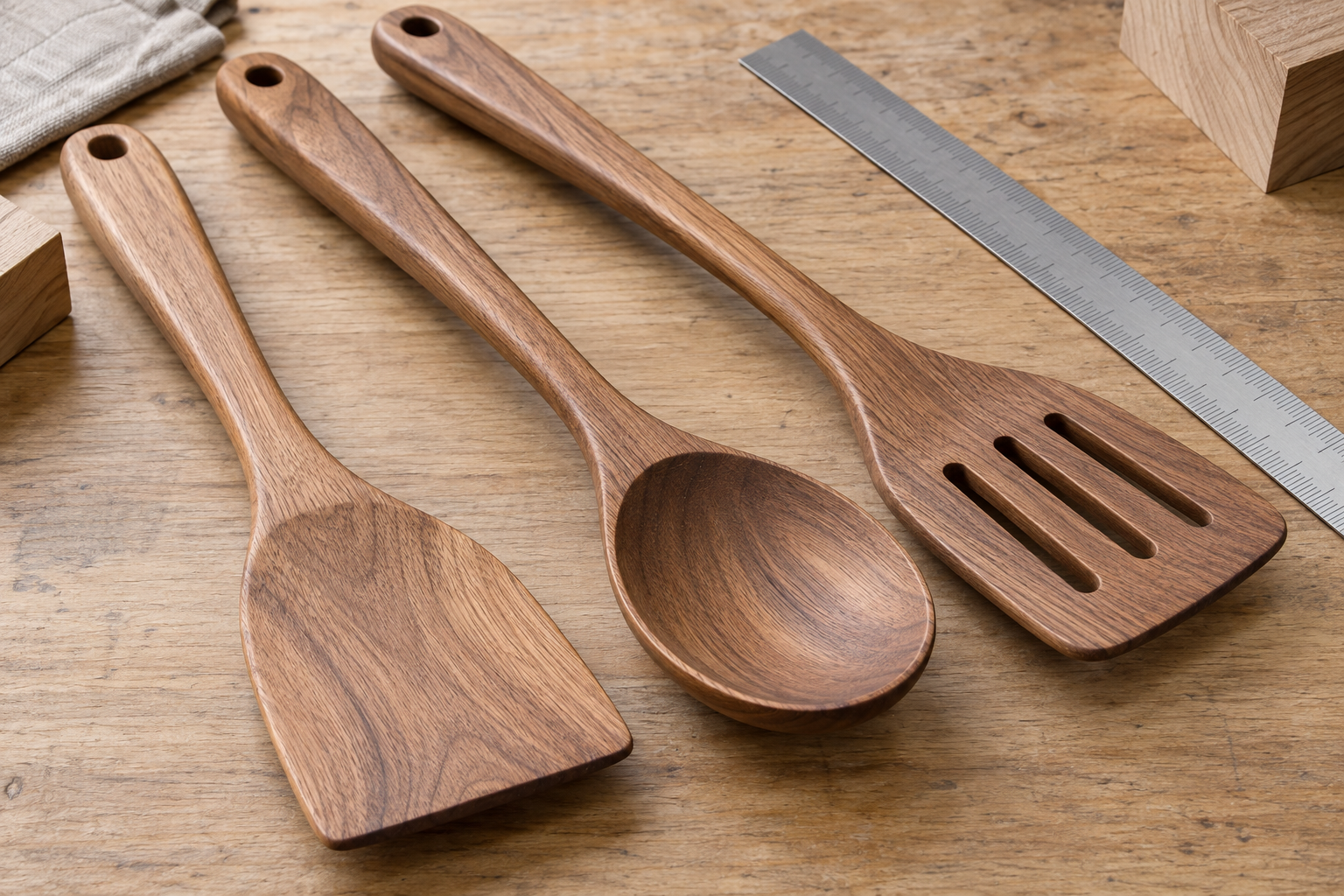
A kitchenware quotation is reliable only when it says what is included. Request the price against a defined SKU list and ask the supplier to state the proposed material, finish, logo method, included accessories, unit packaging, outer carton and commercial conditions. If a set has five pieces, make sure all five pieces are named rather than leaving the set contents to an image.
| Quotation area | Buyer question | Reason to clarify |
|---|---|---|
| SKU scope | Which exact utensils, boards or accessories are included? | A range price cannot be compared if components differ. |
| Material and finish | What material direction and finish are proposed for each SKU? | Appearance and customer care depend on both decisions. |
| Branding | Where will the logo appear, and by which method? | Artwork approval is separate from logo production approval. |
| Packaging | What protects and presents each item, set and export carton? | Missing inserts or weak protection change the delivered product. |
| Commercial basis | What quantity, sample and delivery assumptions underlie the quotation? | Offers should be compared on the same basis. |
Keep the quotation and product brief together. When a buyer changes a component, a finish or a box layout after initial pricing, the supplier should revise the scope rather than rely on informal messages.
5. Approve a sample set, not only one attractive piece
For a single-SKU program, a well-documented sample may be enough to establish a direction. For a utensil set or range, ask to see the actual combination that will be sold. The mix reveals whether the handles, finish, color direction and logo treatment feel coherent together. It also shows whether each piece fits the approved packaging.
Identify the sample type in writing. A stock sample can show general workmanship. A feasibility sample may test a new shape. A pre-production sample is the one that should reflect the approved bulk specification. Do not approve a stock spoon as the final reference for a custom-branded, retail-packed set unless the final elements are genuinely identical.
Inspect the sample from the customer’s perspective. Feel the edges and handle transitions. Check the functional head shape, sanding, visible marks, color variation, logo, hanging hole or other feature, and the completeness of the set. Review the care card and any retail insert as part of the unit. Use photographs and short written notes to record the accepted version.
6. Control sample-to-bulk consistency
After sample approval, bundle the records that define the order: SKU list, drawings or approved reference images, material and finish notes, logo artwork, packaging layout, label copy, care wording and the inspection points. That bundle prevents a product manager, supplier and packaging team from each relying on a different email attachment.
During production review, compare selected units with that record. For wooden kitchen utensils, inspect shape, dimensions, surface smoothness, edge treatment, visible grain variation, finish, logo and component completeness. For a set, open the actual packed unit. A missing utensil, a care leaflet in the wrong language or a changed insert can matter just as much as the wooden part itself. Our wooden product quality-control checklist gives buyers a practical framework for recording those checks.
7. Treat packaging as a range decision
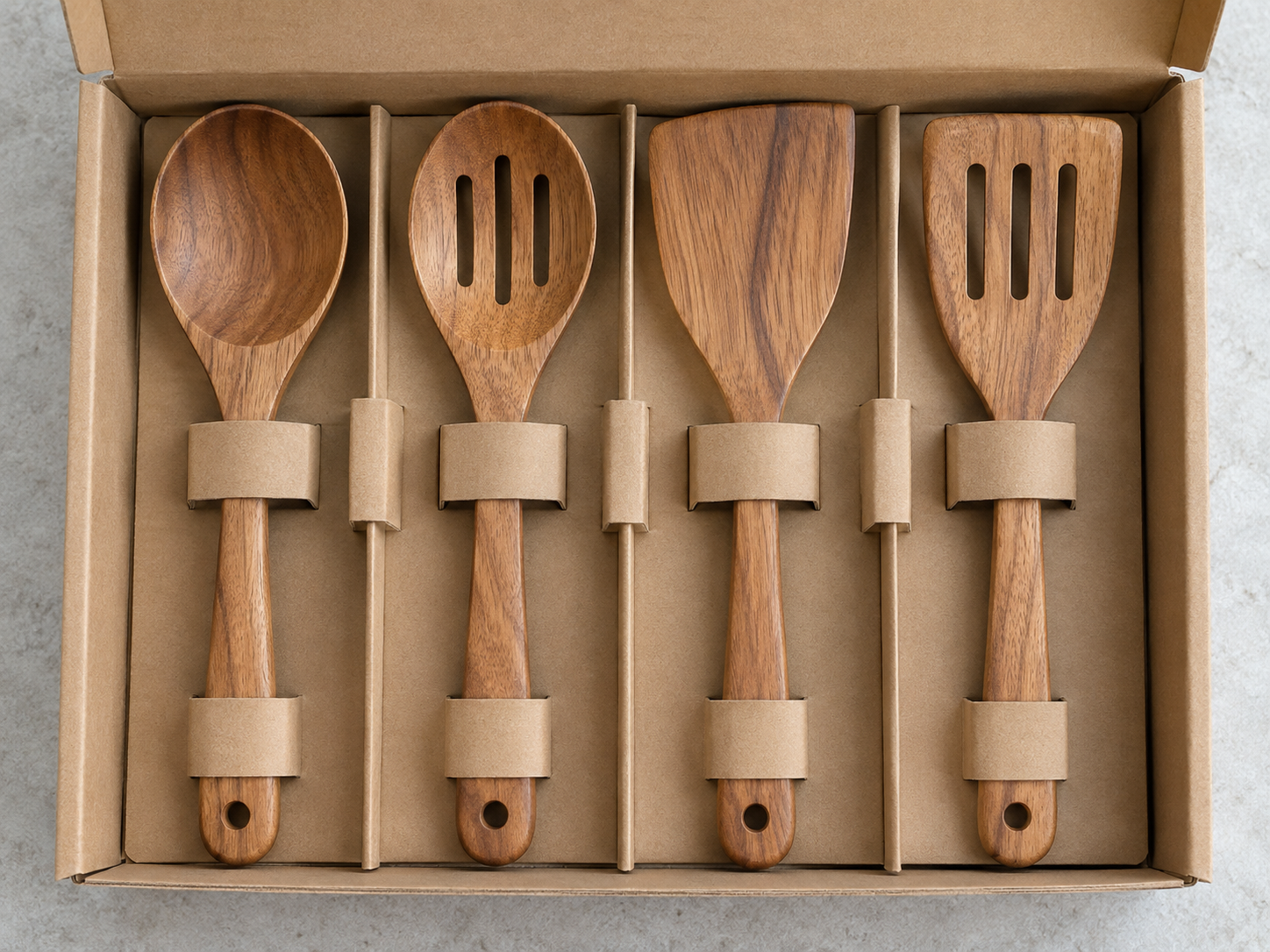
Kitchenware packaging has to manage both presentation and movement. A single spoon may need only a simple sleeve or protective wrap. A gift set may require an insert that keeps pieces separated and in the right order. A mixed export carton needs a packing list and marks that allow the buyer or warehouse team to identify the SKU mix without opening every box.
Open a completed packed unit before shipment release. Check the protective material, arrangement, logo visibility where relevant, care content, outer-carton information and the condition of the product after removal. Confirm that the freight party has the final packing data it needs. The wooden product packaging guide covers the wider export handoff.
Buyer checklist: choosing a wooden kitchenware supplier in China
- Define each SKU, its intended use and its selling format.
- Send the same controlled range brief to each shortlisted supplier.
- Verify supplier evidence against the actual product types in your range.
- Request a quote that identifies material, finish, branding, components and packaging.
- Make food-contact and care information specific to the destination market and buyer requirements.
- Approve a representative sample set with a written record.
- Lock the sample-to-bulk specification before production release.
- Inspect selected product and packed units before shipment.
FAQ
How do I choose a wooden kitchenware supplier in China?
Choose a supplier that can respond specifically to your SKU list, material direction, finish, food-contact questions, branding and packaging. Confirm the fit with a representative sample and documented bulk reference.
What should an importer include in a wooden kitchenware RFQ?
Include the SKU list, intended use, dimensions or reference drawings, material direction, finish, non-wood components, logo, packaging, destination market and the commercial assumptions you need quoted.
How should buyers check a wooden utensil sample?
Check the head shape, handle transition, edges, surface smoothness, grain direction, finish appearance, logo, functional details, set completeness and the finished pack-out.
How do I control a private-label wooden kitchenware set?
Approve the actual set configuration, artwork and packaging together, then keep the final SKU list, reference images, material/finish notes and packing record as the bulk-production reference.
How should wooden kitchenware be packed for export?
Use packing that protects each item from rubbing and movement, keeps set components complete, carries approved care and label information, and gives the freight party the correct final carton data.
Discuss a kitchenware sourcing brief
If you are developing a custom cooking utensil, wooden kitchenware set, board, tray or related private-label range, Cao County Qingtan Muyu Crafts Co., Ltd can review the product brief before sampling. Contact our team with the intended SKUs, material direction and packaging goal to begin a focused sourcing discussion.