
Why Do Wooden Products Crack or Warp? A Guide for Importers
An importer guide to diagnosing wooden product cracking and warping with evidence, construction, shipment, packing and corrective-action checks.
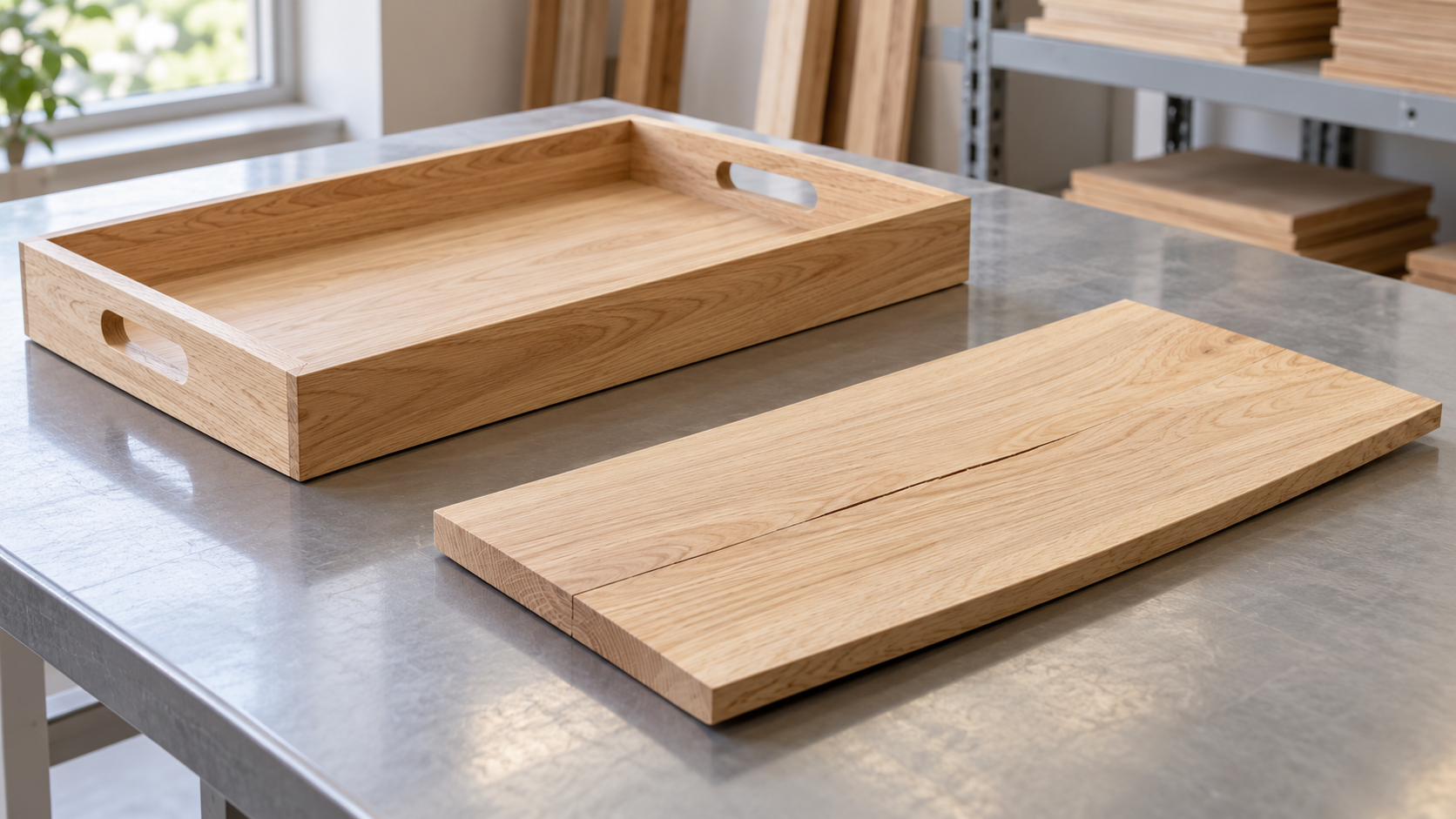
Wooden products usually crack or warp because the wood is responding to a difference between the condition it was made in and the condition it experiences later. Material preparation, part design, assembly, storage, carton protection, and the destination environment can all matter. A photograph of one split tray or a lid that no longer sits flat is useful evidence, but it is not a root-cause report on its own.
For an importer, the practical job is to preserve the evidence, read the symptom carefully, and turn the finding into a specific corrective action for the next order.
Quick answer: what should an importer do first?
Keep the affected units, their inner packing, and the outer carton together until they have been documented. Photograph the item from several angles, photograph the carton and its corners, record the SKU or lot reference available to you, and compare the unit against the approved sample or drawing. If a functional part has moved—for example, a lid, drawer, frame, or hinged panel—record exactly how it no longer works rather than describing it only as “warped.”
Do not immediately sand, wet, clamp, refinish, or discard the piece. Those actions can erase clues. Ask the supplier for the material, construction, inspection, and packing records that relate to that version of the product. Identify the most plausible route and prevent it in the next production run.
Read the symptom before proposing the cause
“Wood warping,” “wood cracks,” “wood splitting,” and “wood shrinkage” are useful search terms, but they describe outcomes, not a single manufacturing fault. The location and direction of the movement matter. A buyer’s evidence pack should make that visible.
| What you see | Questions worth asking | What to preserve |
|---|---|---|
| A split following the grain | Is it near an end, a knot, a joint, a fastener, or a thin section? Did it appear before or after unpacking? | Close and full-item photographs, and the related packing. |
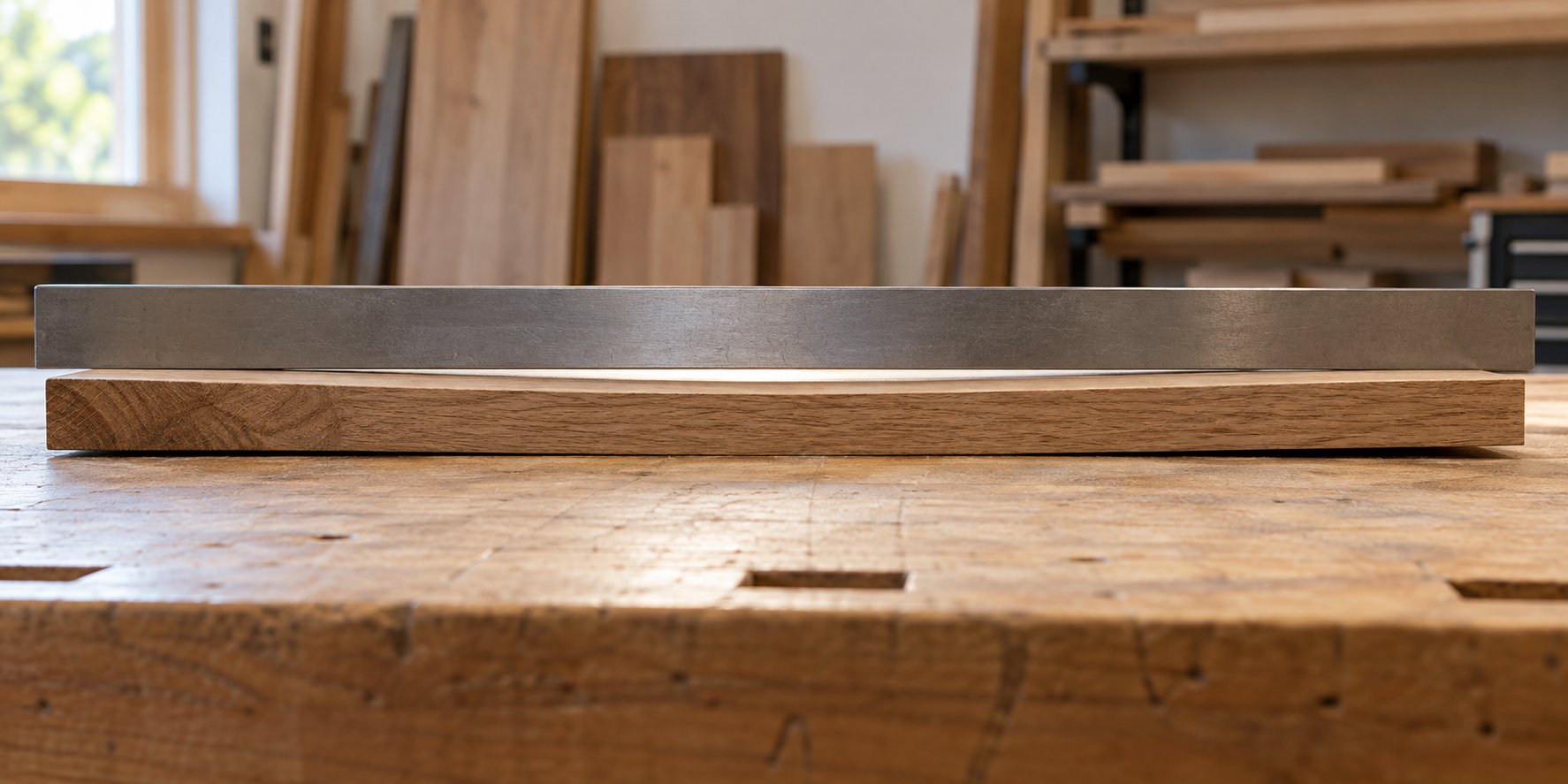
| A cupped, bowed, or twisted panel | Which face is concave? Is the piece a wide solid-wood component? Is the movement uniform across the lot? | A side view with a straight reference and the approved sample or drawing. |
| A lid, drawer, or door that no longer fits | Has the moving part changed shape, or has the surrounding frame moved? Is clearance defined on the drawing? | Photos and a short functional video showing the interference. |
| An opening at a joint or between components | Is the opening along an intended seam, a glued joint, or a material transition? Are other units similar? | Images before handling, SKU/lot information, and any inspection notes. |
| Local crushing plus later movement | Was the carton wet, compressed, punctured, or stored in an unusual condition before delivery? | All carton faces, inner protection, delivery exception notes, and photos taken on arrival. |
A crack at an end and a broad panel that cups are not necessarily the same problem. Nor is every functional issue caused by the wood itself: a tight tolerance, fixed cross-grain connection, misaligned hardware, or a carton that allows a part to flex can create a similar complaint.
Build an evidence pack before the details disappear
A good evidence pack lets a factory compare the returned observation with its sample and process records. Include the purchase order, SKU, drawing revision, carton markings already present, arrival date, quantity checked, and count affected. If a still image does not show the issue, make a short video of the lid rocking, drawer binding, or board lifting from a flat surface.
Keep facts separate from conclusions. “The lid lifts at the right-front corner when placed on a flat surface” is a fact. “The supplier used wet wood” is a hypothesis until records support it.
Common routes to cracking and warping
1. Material condition was not suited to the product and destination
Wood is hygroscopic: it exchanges moisture with surrounding air. That matters most where a product has broad solid-wood faces, close-fitting parts, thin sections, or parts restrained in a frame. A difference between the machining condition and later environment can change a fit or reveal stress.
That does not mean a buyer should request a universal moisture number. The appropriate release condition depends on species, thickness, construction, coating system, intended market, and the product’s function. For a process-led sourcing guide, see how to control wood moisture in custom wooden products. For this article, the important point is diagnostic: ask what material and check process applied to the lot in question, not merely whether the wood was described as kiln dried.
2. The design restricts normal movement
A solid-wood component needs room to respond across the grain. A wide panel fastened rigidly inside a surrounding frame, a lid designed with almost no clearance, or a cross-grain joint treated as if it were a stable sheet material may be more sensitive than it looks in a product photo. The same material can behave differently in a shallow tray, a box lid, and a fitted furniture panel because the construction is different.
Before bulk production, ask the factory to explain which dimensions are function-critical and how the relevant parts are attached. A clear wood-material selection brief should sit beside the drawing; species name alone is not a design solution.
3. Surfaces and storage conditions are unbalanced
Surface treatment can slow moisture exchange, but it does not make wood permanently motionless. A component finished, exposed, stacked, or ventilated differently on one face may respond unevenly. Treat “finish on both sides” as a product-specific review question, not a blanket promise that eliminates movement.
4. Packaging, shipment, or receiving conditions add a separate risk
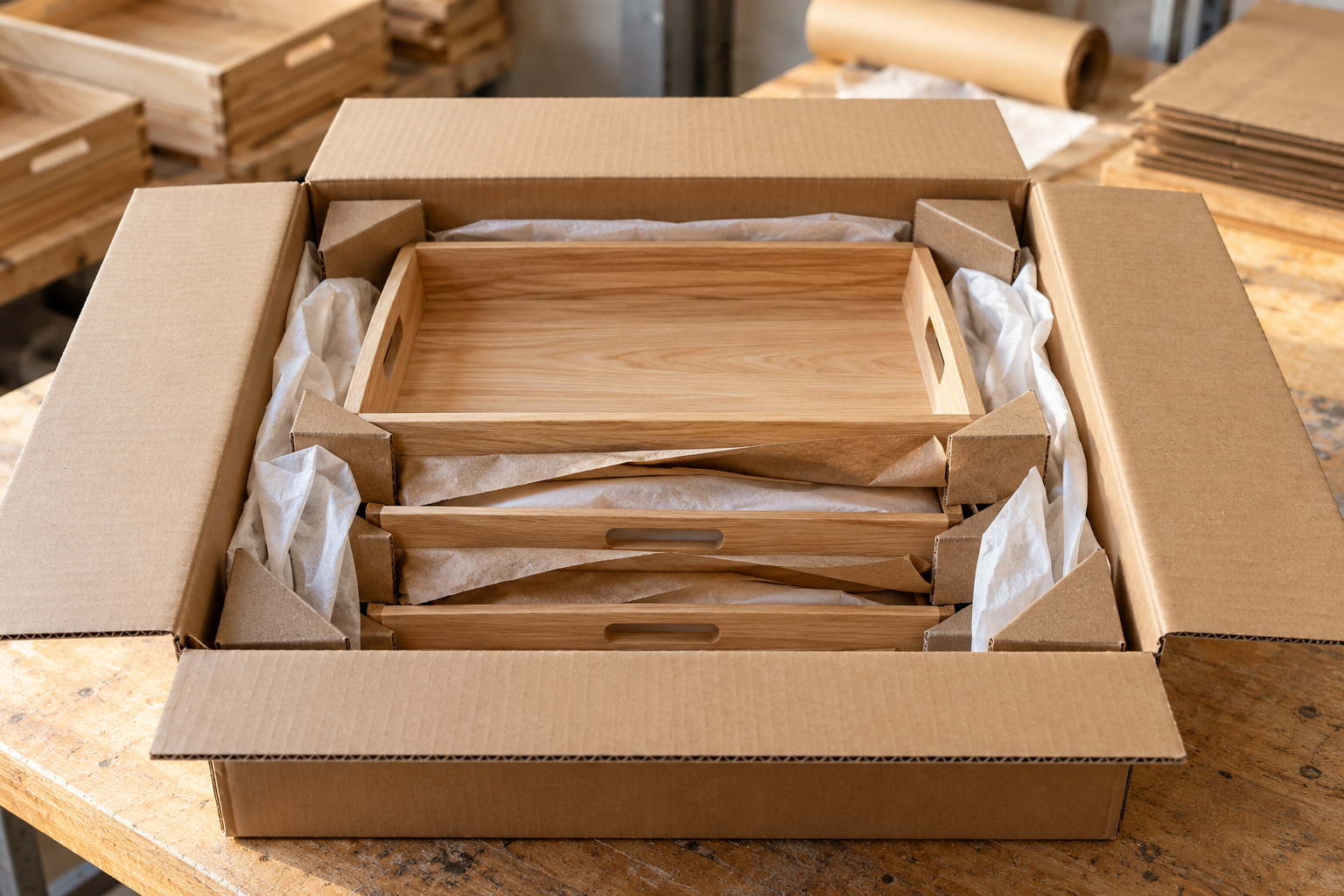
Cartons do not cause every crack, but they can matter. Crushing, moisture exposure, poor internal restraint, or a long period in an unsuitable receiving area may change the condition in which a product arrives. Examine the carton before reducing the issue to a factory-only cause. A careful packing specification should describe separation, corner protection, inner wrap, carton fit, and the way a product is held in place; it should be checked against the actual packed unit. Our wooden product packaging guide for importers covers the questions worth putting into that specification.
Separate production, shipment, and destination factors
A useful root-cause review has three lanes. First, review the factory lane: material preparation, component machining, assembly, finish, in-process handling, and final inspection. Next, review the shipment lane: inner protection, carton condition, consolidation, water exposure, and handling damage. Finally, review the destination lane: how soon the goods were opened, stored, assembled, displayed, or exposed to a markedly different indoor environment.
These lanes prevent the review from stopping at an unsupported claim. A supplier that says “climate issue,” or a buyer that says “bad wood,” has not yet produced a usable corrective action.
Turn the finding into a next-order control
A generic statement such as “please prevent warping” is too broad to verify. Instead, write the change into the purchase-order review, sample approval, or inspection plan. The right action depends on what the review found.
- For a material-condition concern, define the material lot, the agreed measurement method, when checks occur, and what record accompanies the release decision.
- For a design concern, revise the drawing or construction and approve a sample that demonstrates the sensitive function, such as lid fit or panel flatness.
- For a finish or storage concern, identify the relevant product stage and the handling or exposure rule to be checked.
- For a packing concern, approve a packed sample or packing test arrangement and retain photos of the actual export configuration.
- For a recurring complaint, agree the defect definition, check points, sampling approach, disposition route, and who receives the corrective-action record.
Here is a Representative Buyer Scenario, not a customer case: a brand receives storage boxes whose lids bind after arrival. Rather than asking only for “better drying,” the buyer keeps affected units and cartons, compares lid clearance with the approved sample, and records whether the issue appears in one carton group or across several. The evidence determines whether the next order needs a construction review, functional check, material record, packing change, or more than one control.
Importer checklist for a crack or warp complaint
- Quarantine representative affected units without altering them.
- Photograph the whole item, the affected area, all relevant packaging, and carton condition.
- Record SKU, order, lot or carton reference, quantity checked, and quantity affected.
- Compare the unit with the approved sample, drawing, and functional requirements.
- Ask for product-specific material, construction, final-inspection, and packing records.
- Classify the finding as a fact, a question, or a supported conclusion.
- Put the agreed change into the next sample, packing approval, or inspection checklist.
For a broader pre-production review, use this wooden product quality-control checklist and include the relevant movement-sensitive features in your custom wooden product RFQ.
FAQ
Why do wooden products crack after shipping?
Shipping may reveal or add to an existing vulnerability, but it is not automatically the sole cause. Review the crack location, material and construction records, carton condition, inner packing, and what happened after receipt before deciding which control failed.
Can a finish stop wood warping?
No finish should be presented as a guarantee that solid wood will never move. Finishing choices are one part of a product-specific design and handling review; they do not replace suitable material preparation, construction, inspection, and packaging.
How should an importer check a warped wooden product?
Place it on a known flat reference, photograph the condition from the side, show the functional consequence, compare it with the approved sample or drawing, and keep the relevant carton and inner packing for review.
What should buyers ask a wooden products manufacturer after a cracking complaint?
Ask for the material and construction used for the affected version, relevant process and inspection records, packing details, comparison with the approved sample, and a corrective action that can be verified on the next order.
How can a buyer prevent repeat cracking or warping in bulk orders?
Convert the investigation into written, product-specific controls: a defined sample, a functional requirement, agreed material and inspection evidence, and confirmed export packing. Review the same items before the next bulk release.
Discuss the product, not just the symptom
Cao County Qingtan Muyu Crafts Co., Ltd, also known as Cao County Qingtan Muyu Crafts Co., Ltd, works with importers and private-label buyers on custom wooden homeware and related OEM projects. If you have a drawing, sample, or a current issue to review, send an inquiry to woodhomeware.com with the product use, destination market, material preference, dimensions, photos, and the function that must remain stable. That gives the discussion a better starting point than a generic request for “no cracking.”