
Wooden Storage Box Manufacturer: Custom Options for Retail Brands
A retail-brand guide to custom wooden storage boxes: usable dimensions, construction, private label, sample approval, shelf packs and bulk QC.
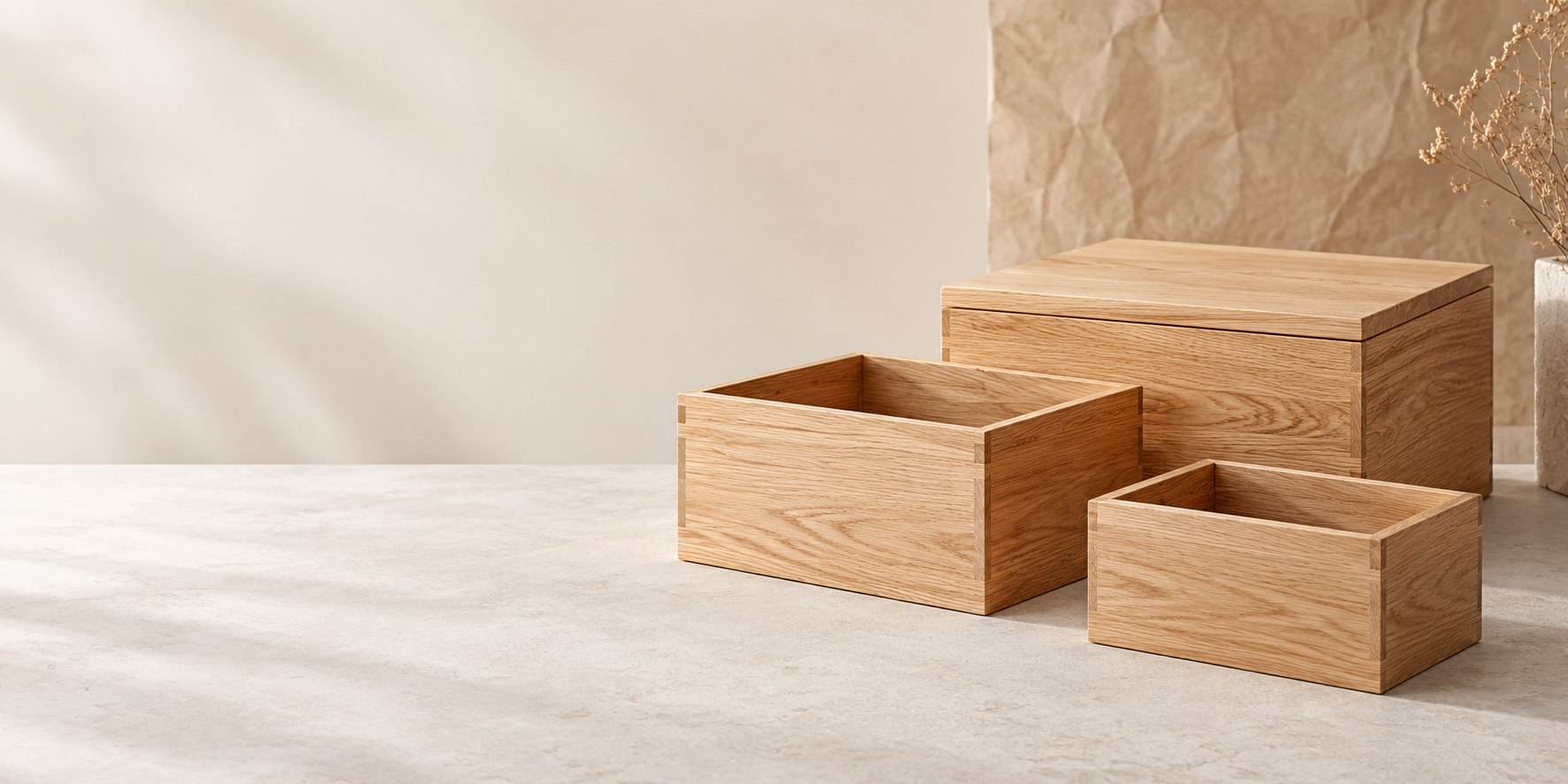
A retail-ready wooden storage box is not defined by its outside shape alone. The buyer needs to know what fits inside, how the lid or divider works, what a customer sees on shelf, and how the item arrives after it has moved through warehouses and cartons. Those decisions should be fixed before a manufacturer is asked for a final quotation.
This guide is for home-organization brands, retailers, importers and private-label teams developing custom wooden storage boxes. It focuses on usable internal size, construction, finish, brand presentation, pack structure and the record linking sample to bulk production.
Quick answer: what should a retail brand give a wooden storage box manufacturer?
Give the manufacturer a clear brief for the actual SKU, not only a reference photograph. Include the intended contents and sales channel, outside and usable internal dimensions, proposed material construction, lid or divider function, finish reference, logo treatment, retail-pack requirement, master-carton requirement and destination. Then approve a physical sample that represents the customer-facing item, including the intended packaging. A loose, unbranded box rarely answers all the questions that matter to a retail launch.
The supplier can then assess whether an existing construction can be adapted or the project needs a new component, fixture or finishing route. Settle that early; a “box with a new logo” may also need a different lid fit, insert or carton.
Begin with the shelf promise, then write the box specification
Retail buyers often start with a visual mood: warm natural wood, tidy shelves and coordinated sizes. Useful direction, but not a specification. State what the customer will use the box for. A keepsake box, pantry container, desk organizer, drawer insert and lidded bathroom box may share a finish but have different priorities.
Write the intended contents plainly. If the box takes a standard item, bundled set or removable insert, provide a representative sample or dimensions. If it will be stacked, explain how it locates on the box below. For a lid, state whether it is lift-off, sliding, hinged or magnetic.
A useful SKU sheet separates four dimensions:
- Outside envelope: the overall size that affects shelf layout, retail pack and master carton.
- Usable inside space: what the customer can actually store after wall thickness, liners, dividers and lid clearance.
- Functional interfaces: lid overlap, handle opening, stack location, drawer fit, divider groove or wall-mount detail where relevant.
- Measurement points: the places both parties will use to verify the finished item.
This avoids a common gap between a nice-looking sample and a box that does not fit the intended contents. It also keeps a buyer from unintentionally comparing quotations based on different wall thicknesses or internal capacity. The custom wooden product RFQ checklist is a useful starting format for gathering that information.
Choose construction for the use, not only for the appearance
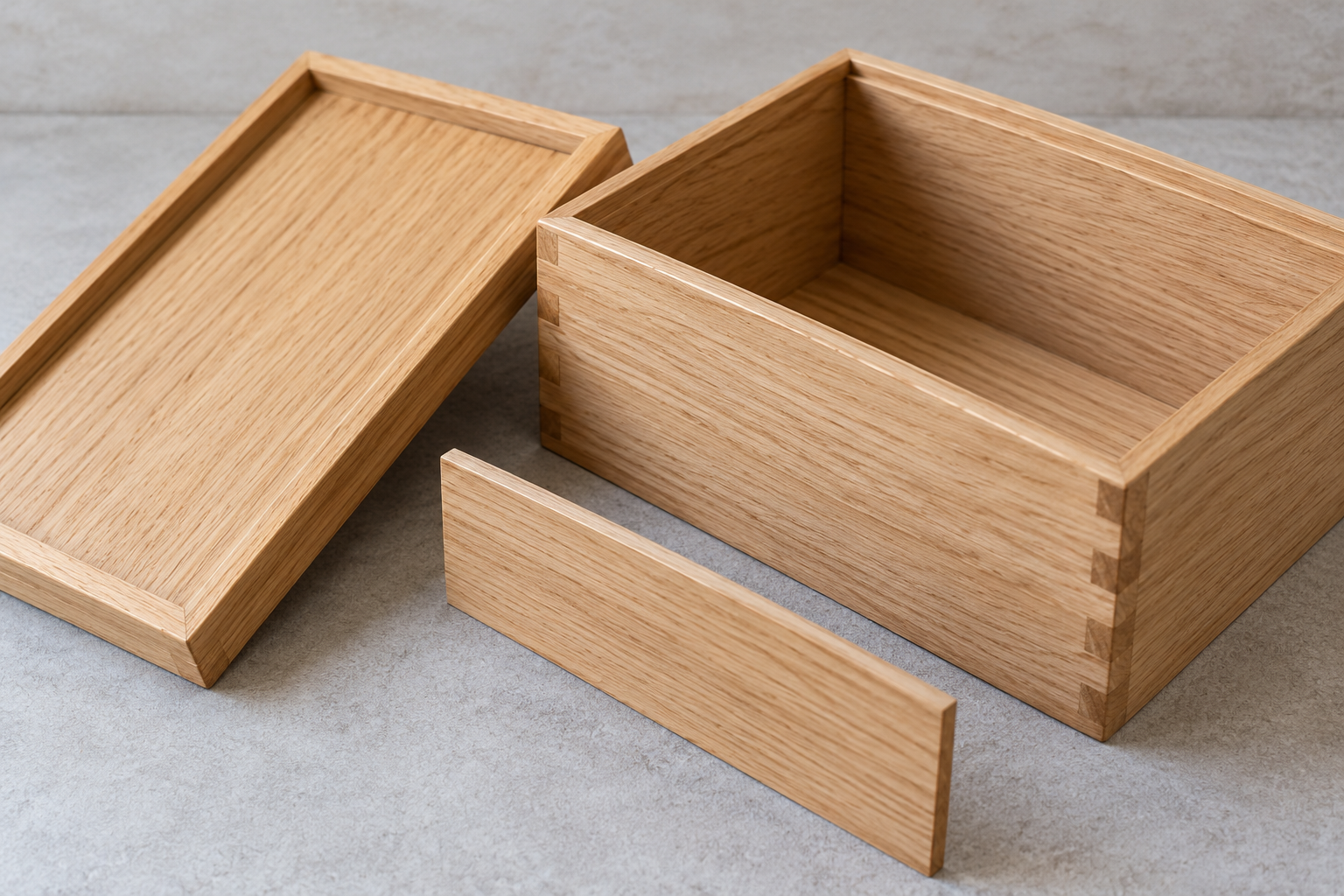
A storage box can use solid wood, a panel construction or a mixed construction, depending on its form, finish and intended use. The material name alone is not enough: the buyer should ask how the sides, base, lid and visible edges are constructed. This helps prevent surprises in weight, interior dimensions, joinery appearance and finish behaviour.
For a retail range, explain which faces are customer-visible and which are hidden. A clear natural finish shows grain, joinery and colour differences more readily than an opaque coating. A painted box shifts attention toward surface smoothness, edge sealing and coverage. The approved reference needs to match the product your customer will open.
Wood changes with its environment. Rather than demanding “no warping,” discuss construction, material preparation, destination climate, wide-panel areas and lid fit. The practical question is how the design accommodates normal movement while keeping needed functions.
Turn a coordinated range into controlled SKUs
A retail brand can make several sizes feel like one collection without forcing every SKU into the same specification. Shared elements may include finish family, logo placement, label format and packaging tone. Each SKU still needs its own drawing, internal capacity, construction notes, accessory list and carton plan.
Build a range matrix before sampling. List every size, lid option, divider option, finish, logo version and retail-pack version. Mark what is common and SKU-specific. It becomes easier to spot a missing instruction sheet, wrong lid or mismatched carton.
Keep colour expectations realistic. Natural grain, texture and shade will vary. A retail buyer can set an acceptable reference range and flag conditions that are not acceptable, such as unapproved patches, surface damage, open joints or an inconsistent finish. The goal is not to make wood look digitally identical; it is to define what belongs in the collection and what does not.
Branding is a product decision, not a last-minute artwork file
For private-label storage boxes, a logo can be engraved, printed, applied as a badge or reserved for the retail packaging. The right choice depends on the selected construction and finish. A mark that looks crisp on one timber or coating can look different on another. Approve it on the same material and finish used for production.
Record the artwork revision, process, placement, orientation and visible-size expectation. Also decide whether the brand story, barcode, instructions and care information belong on a sleeve, hang tag, insert, carton or other pack component. A retailer is buying a customer-facing unit, not just a wooden part. If the packaging carries necessary information, the complete pack must be reviewed with the product inside it.
Approve the sample as the customer will receive it
The best sample for a retail project is not necessarily the first bare prototype. Before bulk release, ask to see the combination you intend to sell: finished box, working lid or hardware, divider or liner if included, logo treatment, retail packaging and the relevant printed components. This is where many avoidable errors become visible—an insert steals too much capacity, a lid rubs after finishing, a label is on the wrong face, or the carton is larger than the shelf plan allowed for.
Create one approval record containing sample photographs, drawings, material and finish statement, artwork file, pack count and agreed appearance references. Identify the version clearly. If a component, material source, finish process or pack method changes, decide whether approval is needed again. This handoff protects the retail specification during bulk production.
Check the details that become retail complaints
Inspection should concentrate on the characteristics the end customer sees and uses. A buyer or appointed inspector can compare random pieces across cartons with the approved record rather than judging one prepared display sample.
| Area | What to check | Why it matters to a retail brand |
|---|---|---|
| Identity | Correct SKU, selected size, finish, logo and pack variant | Prevents mixed variants in one launch or retailer delivery. |
| Function | Lid fit, hinge or magnet action, divider fit, stacking and base stability where applicable | These are the first functions a customer experiences. |
| Visible finish | Sanding, rough edges, glue residue, open joints, cracks, coating coverage and approved variation | Natural variation is different from workmanship defects. |
| Dimensions | Outside size, usable internal space and critical interfaces at the agreed points | Protects shelf plans, inserts and customer storage use. |
| Pack components | Correct retail carton, label, insert, accessories and master-carton quantity | Protects saleability and receiving accuracy. |
Use a product-specific version of the wooden product quality-control checklist. It is especially important to distinguish natural wood character from a fault, so the inspection decision is repeatable rather than based on personal preference on the day.
Design the retail pack and export carton together
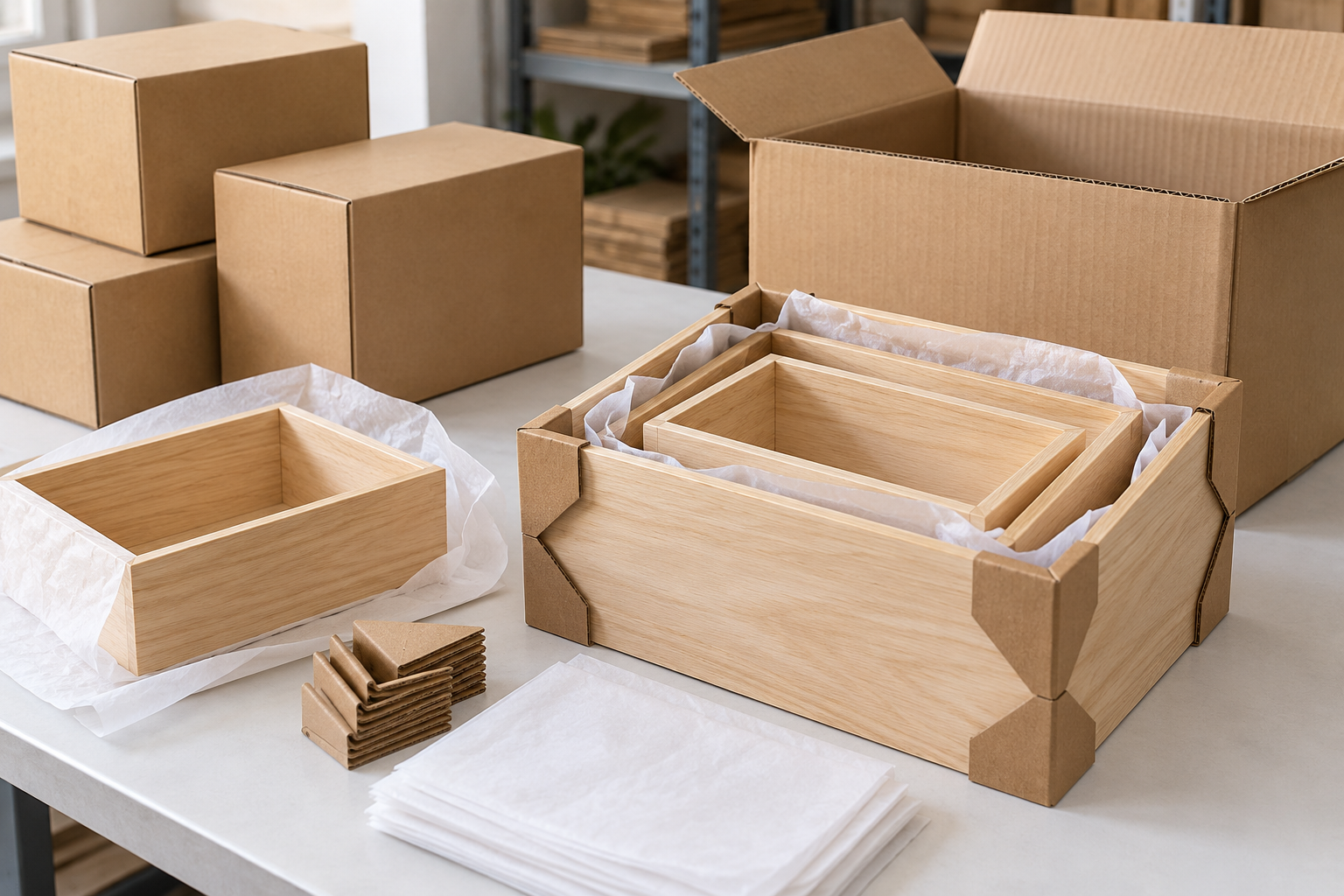
Wooden storage boxes can consume more shipping volume than expected, especially when lids, handles or fixed dividers prevent nesting. Packaging should be part of development. A compact master carton is useful only if it does not cause abrasion, corner damage, loose hardware or a poor unboxing experience.
Ask to review the full pack-out: the wrap or tissue against finished faces, corner protection where needed, restraint for loose components, retail carton fit, master-carton quantity and carton closure. For e-commerce, the individual parcel route may need a different protection approach from palletized wholesale distribution. The wooden product packaging guide can help structure that review.
Buyer checklist for custom wooden storage boxes
- Describe the customer use and intended contents for each SKU.
- State outside size, usable internal size and all functional measurement points.
- Define lid, divider, handle, stacking or mounting details clearly.
- Confirm construction, visible faces, finish reference and acceptable natural variation.
- Map each SKU, variant, artwork and retail-pack version before sampling.
- Approve branding on the actual production material and finish.
- Review a finished, customer-facing sample rather than only a bare box.
- Keep the approved sample and revision record linked to the order.
- Inspect function, finish, dimensions and pack contents across cartons.
- Approve the retail pack and master-carton pack-out together.
FAQ
What custom options can a wooden storage box manufacturer offer to retail brands?
Options may include dimensions, internal layout, lid or handle design, material construction, finish, logo method, inserts, labels, retail packaging and export cartons. The available combination should be confirmed against the proposed SKU rather than assumed from a catalogue image.
How do I make sure a storage box fits the customer’s intended use?
Specify both outside dimensions and usable internal space, then provide the intended contents or a representative sample. Test the box, lid, divider and pack with that use before approving bulk production.
Can a retail range use one finish across several wooden box sizes?
Yes, but each substrate and SKU should be reviewed against the approved reference. Natural wood and different construction surfaces can take a finish differently, so shared colour intent does not remove the need for SKU-level approval.
What should I inspect on a wooden storage box before shipment?
Check the SKU, dimensions, functional fit, stability, edges, joinery, finish, branding, included components and complete pack-out against the approved record. Draw samples from more than one carton.
Why should retail packaging be approved with the wooden box?
Packaging affects product protection, shelf presentation, information placement and carton efficiency. Reviewing it with the finished box catches fit, label and protection problems that a loose-product sample cannot show.
Prepare a clearer retail brief
Cao County Qingtan Muyu Crafts Co., Ltd, Cao County Qingtan Muyu Crafts Co., Ltd, works with B2B buyers developing custom wooden homeware and storage products. For a retail-box project, send the intended use, dimensions, construction preference, finish reference, brand treatment, pack requirement and destination through our inquiry page. A well-defined retail brief gives a manufacturer a sound basis for sampling and a buyer a better basis for comparing offers.