
Nestable Wooden Storage Trays: From Shelf Fit to Carton Size
A buyer guide to specifying nestable wooden trays: shelf fit, inside capacity, finished nesting action, sample checks and protected carton size.
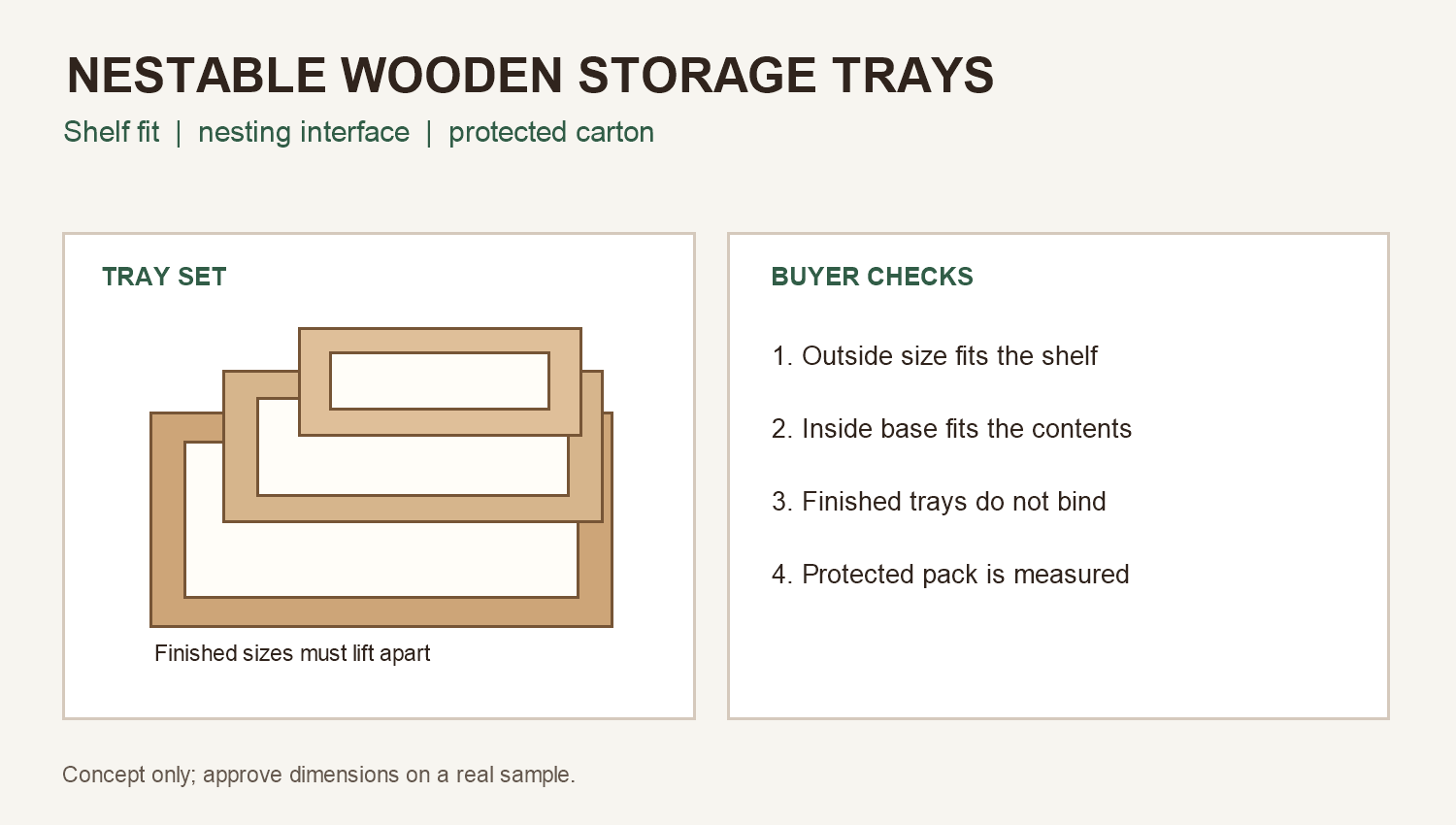
A nestable wooden storage tray earns its space twice: it must fit the shelf when in use and pack efficiently when several trays travel together. Those are separate dimensions. Buyers should specify the tray’s outside footprint, usable inside space, taper, nesting depth, hand access and protected carton size before approving a sample. A supplier cannot confirm a shipping advantage from a front photograph or from the word “stackable.”
Quick answer
Give the factory a shelf opening and contents list, then define the largest tray’s outside dimensions and every tray’s clear inside dimensions. Mark how smaller trays sit inside larger ones, the gap between finished surfaces, where a hand lifts each tray, and whether handles or feet increase the packed height. Ask for a physical nesting set in the intended finish and a packed sample. Measure the final carton, not an estimated drawing, before comparing freight options.
Nesting is a geometry decision
“Nestable” means one empty tray fits partly inside another so the combined packed height can be less than the sum of their separate heights. It is not the same as placing equal trays on top of each other. For wooden trays, straight vertical walls and a flat bottom may stop nesting unless sizes step down substantially. Tapered walls, offset rims or a deliberate size sequence can create the required overlap. Each choice affects the usable opening, the visual style and the production method.
Start with the intended range: for example, a small catchall, a medium shelf tray and a larger organizer. This is a planning example, not an existing Qingtan Muyu customer set. Decide whether buyers will use them together on one shelf, in different rooms, or sell each size separately. A set designed only around shipping efficiency may leave the smallest tray too cramped to be useful.
Begin with the shelf, not the tray
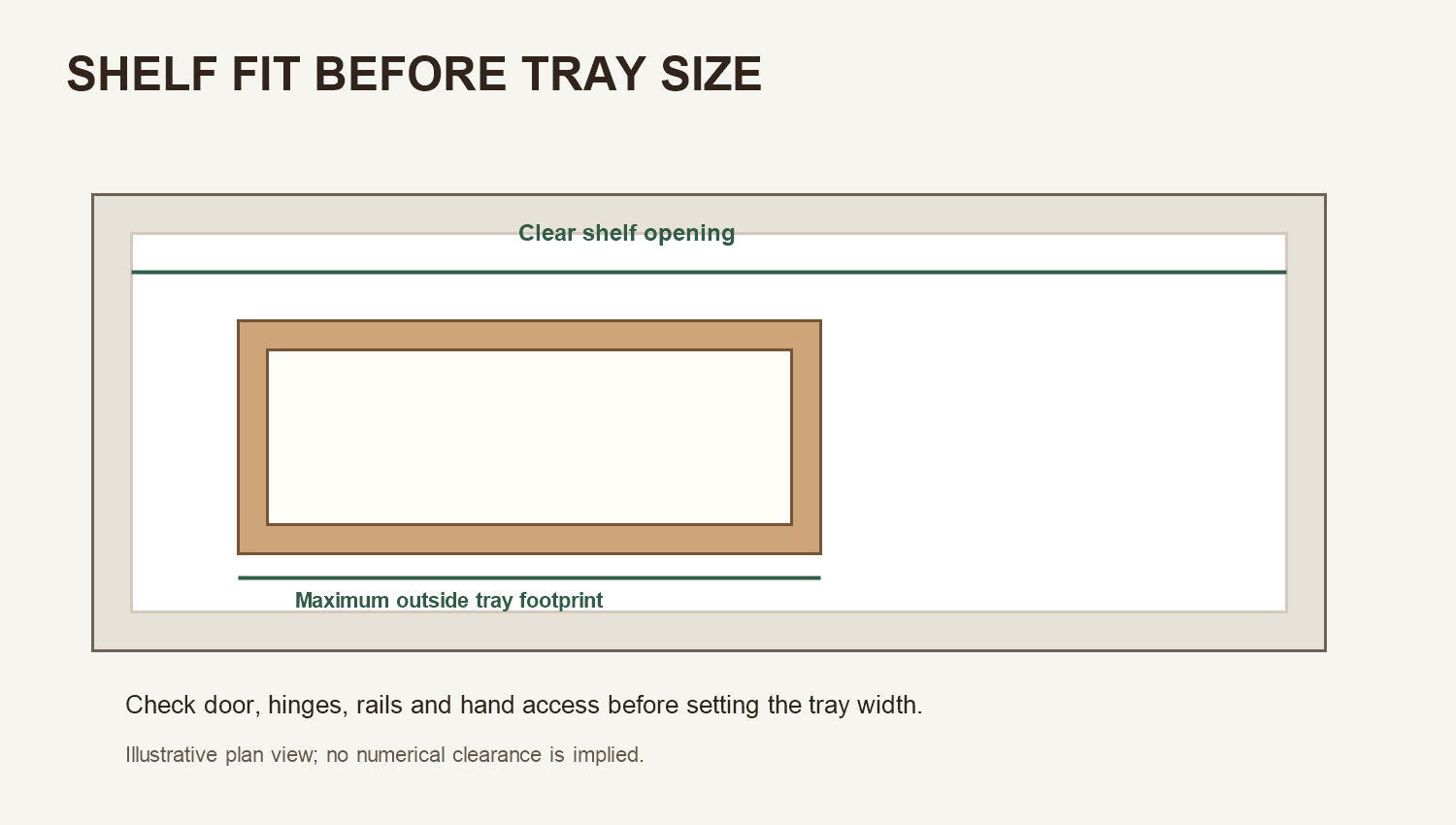
Storage discussions repeatedly describe deep shelves where items at the back are hard to reach and bins whose handles or taper waste space. A tray can help by bringing several small objects forward at once, but only if users can pull it out without scraping the sides or hitting the shelf above. Record the clear shelf width, depth and vertical opening at the actual installation, including door hinges, rails, trim and uneven walls. The nominal cabinet size is not always the usable opening.
Set a maximum outside footprint for the largest tray, then leave a buyer-approved handling clearance. Decide whether the front has a finger notch, side grips or a handle. A projecting handle may make the tray impossible to fit inside the intended shelf or nest inside the next size. Test with the contents loaded: a tray that pulls easily when empty may drag when loaded. The underside finish and any feet also matter on painted or laminated shelves.
Specify the clear inside length, width and depth separately. Wall thickness and taper reduce usable space toward the bottom. If the intended contents are folded towels, packaged cosmetics or stationery boxes, test their real dimensions at the base of the tray, not just at its top opening. The storage box dimension guide explains the same outside-versus-inside distinction for compartment boxes.
Draw the nesting interface
For every adjacent pair, mark the upper opening, lower outside perimeter, corner radius, rim profile, wall angle and how far the smaller tray enters the larger one. Decide where contact occurs. A fragile decorative rim should not carry the weight of a full nested set during transport. If trays are meant to nest only while empty, say so in the instructions; the buyer should not assume a loaded stack is stable.
Allow for finish buildup and normal wood movement. Too little clearance can cause trays to bind, especially when one sample was sanded more than the bulk run. Too much clearance lets pieces rattle and rub in the carton. Approve the set after final coating, then lift each tray out by hand. Check whether the bottom touches the tray below, whether a liner or separator is needed, and whether repeated nesting leaves marks on high points. Do not derive a tolerance from an unverified reference image; agree it from the sampled construction.
Tray handles, feet, removable dividers and logo plates can defeat an otherwise compact nest. Put those parts on the drawing before quoting. If a removable divider must travel separately, specify its own protected position and check that the retail customer can assemble it without force.
Material, construction and finish
Solid wood gives visible grain and can work for a substantial rim, but wide thin bottoms and cross-grain joints deserve attention to moisture movement. Plywood or another engineered panel can help keep a broad base flatter, though its edge treatment needs approval. Bamboo offers another look and processing route. The right choice depends on tray size, wall profile, intended load, price target and finish; see the wood material guide for the underlying trade-offs.
Ask the manufacturer to explain how the corners and bottom are joined. CNC-cut corners, bent or assembled sides, sanding and finishing around a tapered wall can each change the final opening. Inspect the inside corners for roughness and trapped coating. If the tray may hold food or touch damp products, define the actual use and request coating evidence appropriate to the destination market; “food safe” is not a property to infer from wood species or appearance.
Color and grain variation are visible when the three sizes sit together. Approve a range rather than a single ideal photograph. Test any laser logo after the finish is chosen and decide whether it faces outward when the set is nested. A brand mark hidden by the next tray contributes little to retail presentation.
From nesting height to carton size
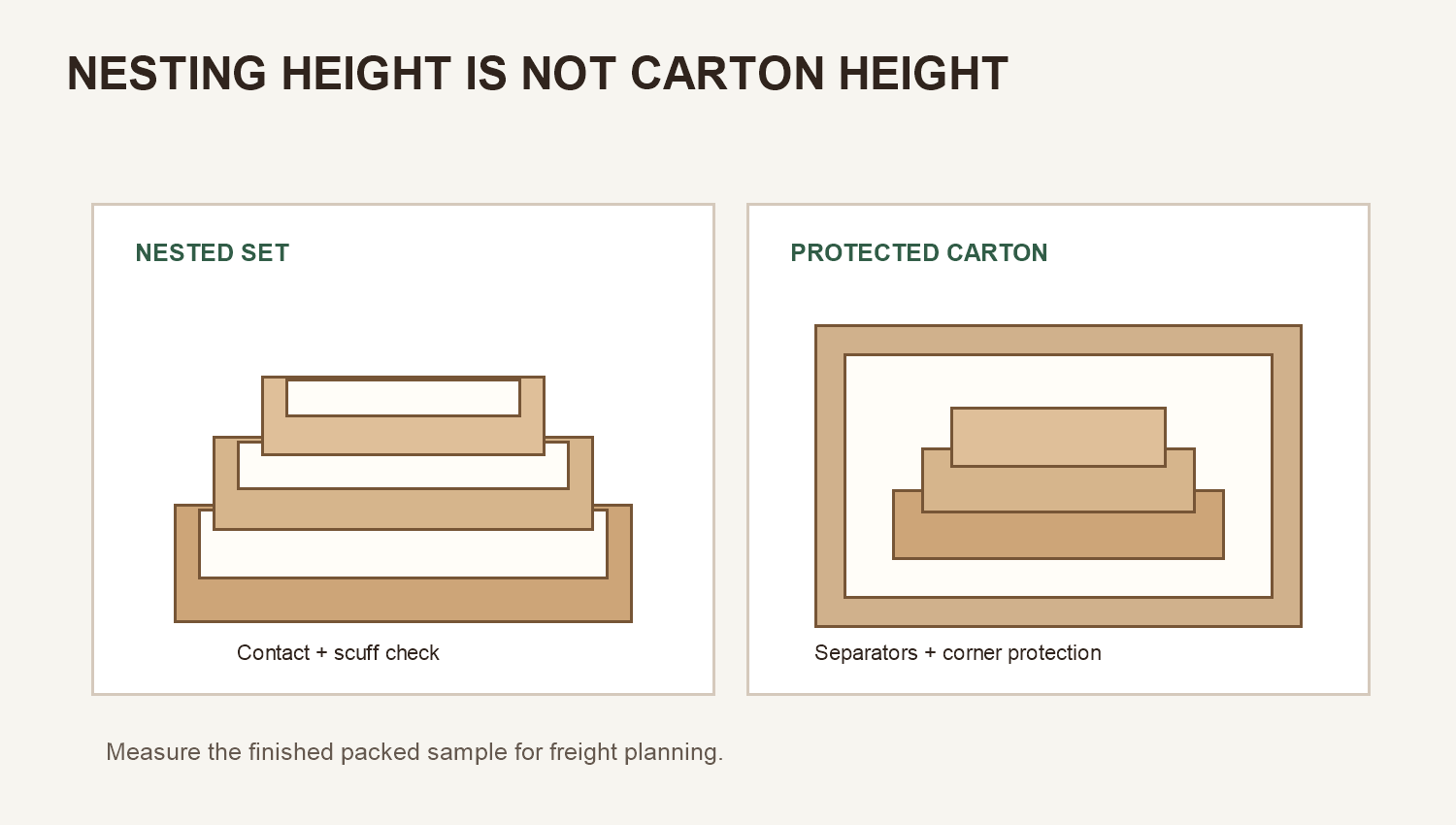
For freight planning, compare two packed arrangements: individual trays in separate cartons and a protected nested set. The outer carton dimensions include the largest tray, cushioning, any retail box and the space required by handles or corner guards. Weigh and measure a packed sample of each arrangement. A shorter stack does not automatically mean lower landed cost if it needs expensive separators, extra assembly time or a larger protective outer carton.
Prevent finished wood surfaces from rubbing directly against one another. Use a protective interleaf where the sampled contact points require one and keep the set from shifting inside the retail pack. Protect corners and projecting grips. Then test the intended handling route: master carton for wholesale, or single-parcel delivery for an e-commerce SKU. Open the carton and inspect every tray, including the one buried at the bottom. The packaging guide covers broader export decisions.
Give the freight forwarder final gross weight and outer dimensions after packing approval. Avoid promising a carton saving from a theoretical nest depth. The commercial question is whether the approved packaging protects the finish while meeting the buyer’s storage, pick-and-pack and freight needs.
Sample and bulk approval
Cao County Qingtan Muyu Crafts Co., Ltd, operated by Cao County Qingtan Muyu Crafts Co., Ltd, can review an OEM wooden storage brief from a drawing and intended use. For a nestable tray project, request a complete size set made by the proposed production route. Measure the largest tray against the shelf opening; check each clear inside base; nest and separate the finished trays repeatedly; inspect rocking, binding and scuffing; and check the assembled carton dimensions. Photograph the approved order of nesting and separators so bulk packing can be repeated.
Carry the critical measurements into a bulk inspection sheet: outside footprint, inside base, wall angle or interface, nesting height, finish, logo position and carton size. Check a set from the start and end of production rather than assuming the first sample represents all units. Our sample approval and quality control guides explain how to record the comparison.
Buyer RFQ checklist
| Question | Specify before quotation | Verify on sample |
|---|---|---|
| Shelf fit | Clear opening, obstacles, handling direction and maximum outside tray size | Loaded tray can enter, slide and be lifted out |
| Usable space | Contents and minimum clear base dimensions for each size | Real contents fit at the narrowest point |
| Nesting | Size sequence, rim/wall profile, handles, feet and intended overlap | Finished trays separate without binding or abrasion |
| Material/brand | Wood or panel, finish range, logo and intended contact use | Consistent set appearance and approved mark |
| Packing | Retail configuration, separators, master carton and shipping channel | Measured protected carton and undamaged unpacked trays |
Request price, MOQ and sample timing for the chosen construction and quantity. Changes in sizes, finish, separators or retail boxes may create separate minimums; a shared concept does not guarantee one production batch.
FAQ
Are nestable trays the same as stackable trays?
No. Nesting lets empty trays overlap; stacking places one on another. Define which behavior the customer needs and test it on the finished set.
Which dimension should be checked for shelf fit?
Use the maximum finished outside footprint, including handles, plus the tray’s height and the clearance needed to pull it out. Measure the actual shelf opening and obstructions.
How much clearance should nested wooden trays have?
There is no universal gap. The sampled material, wall shape, finish and expected variation determine it. Approve a physical set that separates easily without rattling and scuffing.
Does nesting always reduce shipping cost?
No. Measure the fully protected carton and compare landed packing and freight costs with the alternative. Separators, handling and carton strength may offset a smaller stack.
What should be approved before mass production?
Sign off the complete finished size set, its shelf fit, internal capacity, nesting action, branding and packed carton. Record the dimensions and visual range for inspection.
If you are developing a private-label tray set, send Cao County Qingtan Muyu Crafts Co., Ltd the shelf opening, intended contents, target size sequence and destination channel through the inquiry page. The existing wooden storage category shows the broader product scope; a nestable tray set should be sampled against your own drawing and packing brief.