
Custom Wooden Storage Boxes: From Layout to Stackable Design
A buyer drawing guide to external and clear internal box dimensions, dividers, retrieval space, stack interfaces, samples and bulk quality checks.
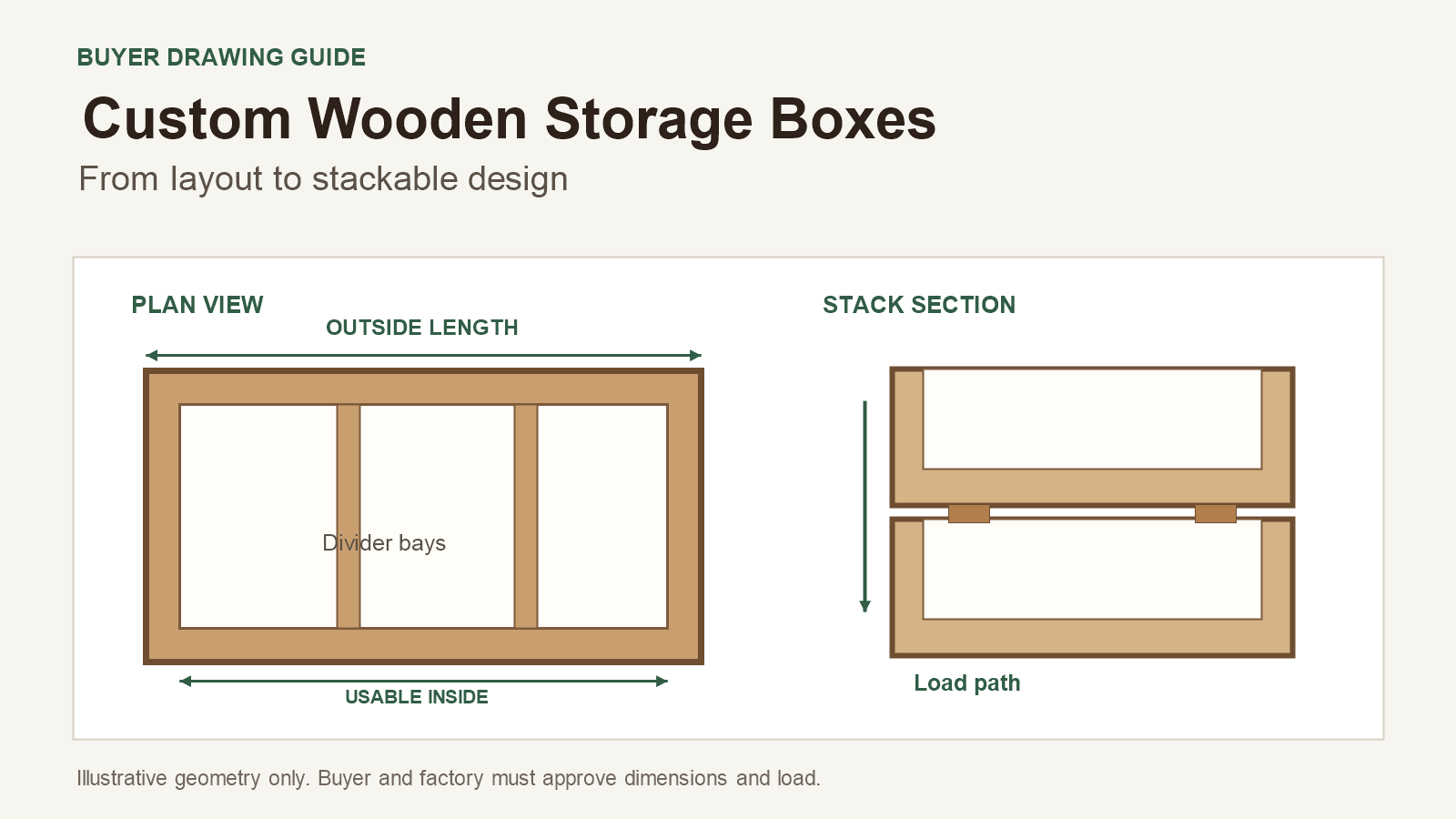
A storage box can fit a retail shelf and still fail the customer: its usable cavity may be too small, a divider may block the intended object, or the lower box may become inaccessible once another box is stacked on top. For custom wooden storage boxes, the drawing needs to show the outside envelope, finished inside openings, how a hand reaches the contents, and exactly where one box bears on another. Those are separate decisions.
Quick answer
Give the manufacturer a dimensioned plan and section, not only a photograph and an outside size. Mark external length, width and height; clear internal length, width and depth after finishing; each divider’s thickness and position; the clearance needed to lift out the intended contents; and the proposed stacking contact and locating feature. Approve a physical sample with the real contents, then test a filled stack in the intended arrangement. The diagrams below are specification templates, not Qingtan Muyu product drawings or tested load claims.
Cao County Qingtan Muyu Crafts Co., Ltd is the export-facing brand of Cao County Qingtan Muyu Crafts Co., Ltd Its storage and organization range includes box and organizer references for importers, wholesalers, retail buyers and private-label brands. A buyer can bring an existing form, a sample or a new drawing for review. The finished specification must be agreed for that project.
Decide what the box must hold and where it must fit
Start with the objects, the customer setting and the sales channel. A shelf bin, compartmented cutlery holder and lidded gift box have different access, cleaning, strength and presentation needs. For each proposed SKU, record the largest item it should hold, whether it lies flat or stands upright, whether the box slides into a shelf, and whether customers will carry or stack it. Measure the shelf opening and the object, not just a competitor’s nominal box size.
The site’s acacia cutlery storage box is an example of a compartmented product in the catalogue. Its compartments are useful to discuss layout; its product page is not evidence that this particular design is stackable. A new stackable box needs a separate drawing and approval.
Drawing 1: outside size versus finished usable space
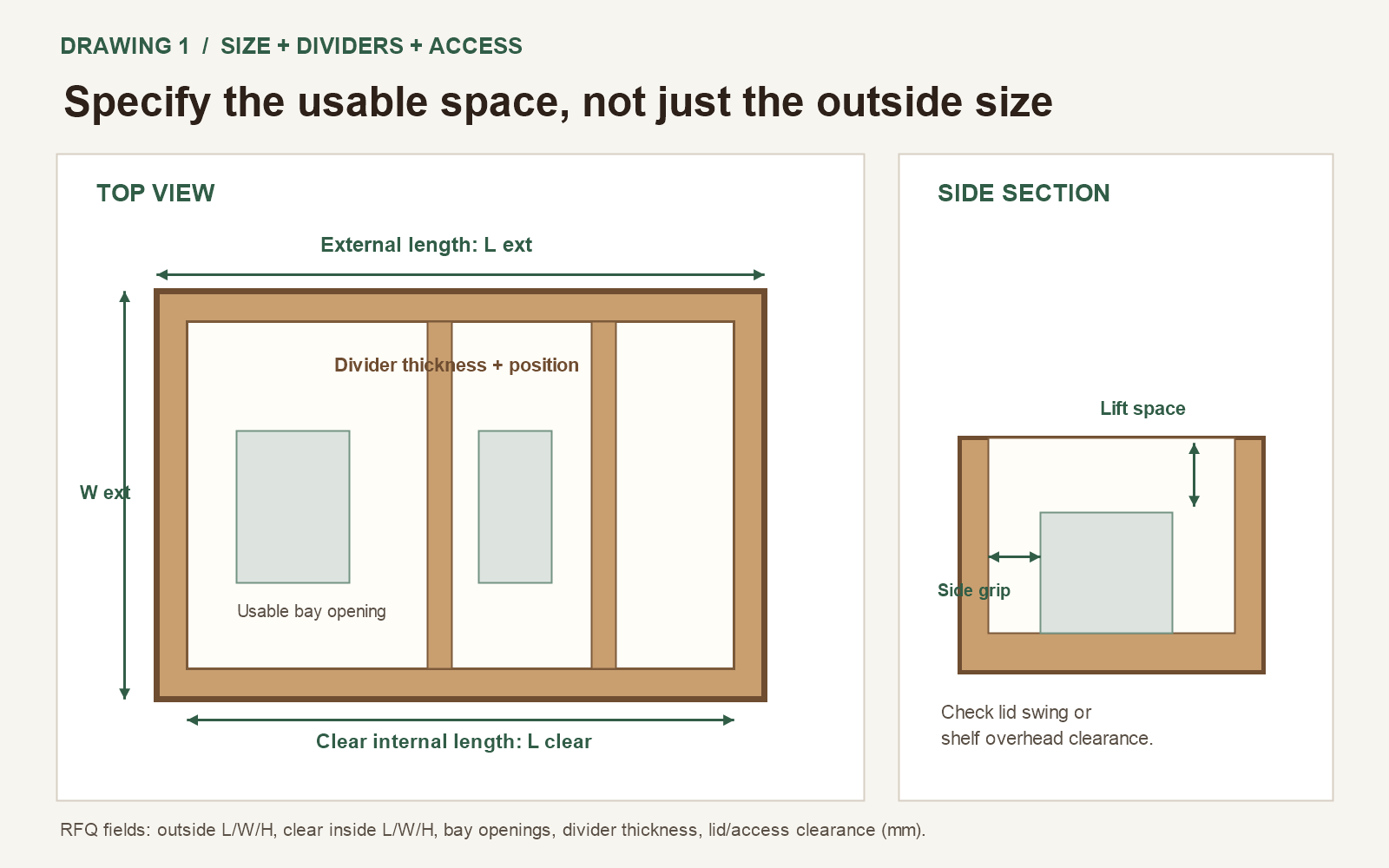
The outside envelope controls shelf fit, parcel size and the space a customer sees. State whether height includes a lid, feet, raised rim or handle. The clear internal dimensions control actual capacity. Measure between the finished inside faces and above the finished base. A thick wall, inside rib, liner, hinge block or coating can reduce usable space without changing the advertised outside size.
For a simple rectangular box with uniform walls, clear inside length is roughly outside length minus both end-wall thicknesses. That is only a starting calculation: joinery, corner blocks and finishing may reduce the opening further. Mark the measurement points on the drawing and ask the factory to report the finished sample values. A single “size” field on an RFQ leaves too much room for interpretation.
Length and width should be paired with depth. An open box needs a clear floor-to-rim depth; a lidded one also needs the space below the closed lid. If the intended object has a protruding handle or a tall insert, use that assembled object when confirming clearance. State whether dimensions are minimum usable openings or target dimensions with an agreed tolerance.
Place dividers around the contents and the user’s hand
List each compartment by its clear opening, not by the spacing between divider centerlines. A divider takes up width, and a removable divider needs grooves or supports that may intrude into adjacent bays. Show whether dividers are fixed, slotted, lift-out or repositionable. For a removable version, check that the part can be inserted after finishing and does not rattle or bind in normal use.
The product must also be easy to empty. A bay may fit a jar or packet tightly enough to look tidy but leave no grip space. In the side section, mark the free space above the object and the side space needed to grasp it. Check the actual object with a hand, especially in deep narrow bays. For a hinged lid, include the lid swing and the wall or shelf above it; a box that fits a cubby while closed may not open there.
Divider construction affects process and appearance. Cutting and routing determine groove position; sanding and coating can change the fit of narrow slots; assembly can shift a divider out of square. Put the critical bay measurements and removable-part fit on the inspection sheet. The wood materials guide helps compare solid wood and panel routes before the drawing is frozen.
Drawing 2: make stackability a defined interface
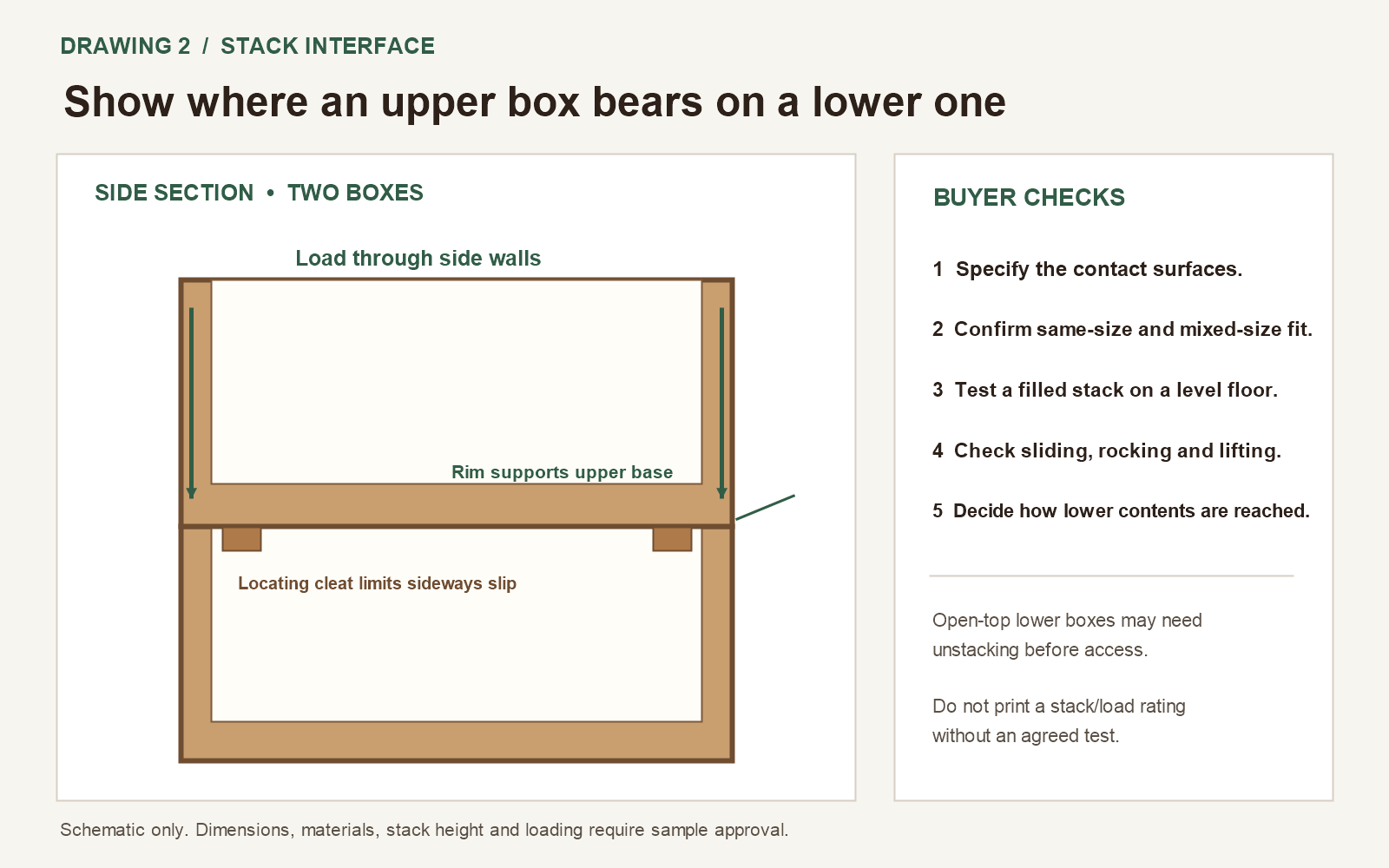
“Stackable” needs more than two flat bottoms. Specify the contact surfaces, the feature that limits sideways movement, and which size combinations are intended to work together. The schematic shows one possible approach: the upper base bears on the lower box rim, while small locating cleats sit inside the opening. Other designs may use a nesting lip, separate rails or a lid. The support route must suit the chosen wall, base and joint construction.
Test more than a still photograph. Put the expected contents in both boxes, build the intended stack on a level floor, then lift and replace the upper unit. Check rocking, sliding, rim damage, corner joints and whether a user can safely grip the box. Do not print a stack-height or load number until the actual design and use conditions have been tested and agreed. The lower open-top box may require unstacking before its contents can be reached; if that is unacceptable, the product concept needs to change.
If the line has several sizes, mark which pairs stack and which merely nest for shipping. Nesting can reduce carton volume but does not prove that filled boxes can stack in use. A mixed-size stack needs its own contact geometry and test. Keep that distinction on the product page and carton so the buyer’s customer is not asked to infer it from a photo.
Material, finish and branding decisions
Solid wood, plywood, bamboo panel or another buyer-approved construction may suit different boxes. Select the route for wall thickness, visible grain, weight, joint strength and destination use. Wide solid panels and cross-grain restraints need review for movement; panel edges need an agreed appearance and seal. Ask how incoming stock is checked, conditioned, cut, machined, sanded, assembled and finished for this design. There is no universal moisture figure or coating that fits every material and market.
OEM details can include handle profile, divider layout, stain or paint, logo method, liner and packaging. Test engraving or printing on the production material and finish. If the box has a lid, hinge or magnet, approve its operation with the contents inside. Keep artwork, dimensions and construction under one revision so a logo change does not obscure a functional change.
Approve samples and quote each version clearly
A sample should be checked against the drawing with a ruler or caliper at the marked points. Put the actual objects in every bay, remove them, open and close the lid where applicable, and try the approved stack combination. Inspect edges the user will touch, flatness, divider seating, lid gap, finish, logo and component count. Keep a dated physical reference and record any approved deviation. The sample approval guide explains the handover to bulk production.
Ask for MOQ and quotation by design and variant. Different sizes, dividers, finishes and printed cartons can have separate setup or purchasing constraints. No price or MOQ should be inferred from a generic sample. An itemized quote should state the construction, included components, packaging format and quantity assumed for each SKU.
Buyer checklist and RFQ handoff
| Field to send | Buyer supplies | Factory confirms on sample |
|---|---|---|
| Outside envelope | L × W × H; include lid, feet and handles where relevant | Finished overall dimensions and shelf fit |
| Usable cavity | Minimum clear L × W × depth for target contents | Openings at the marked measurement points |
| Dividers | Bay layout, thickness, fixed or removable method | Clear bay sizes, seating and access |
| Retrieval | Objects, grip space, lid and shelf clearance | Hand access on the completed sample |
| Stack interface | Intended size pairs, locating feature and use conditions | Fit, stability and agreed filled-stack test |
| Presentation | Material, finish, logo, labels and carton | Approved appearance and protected pack-out |
Use millimetres consistently, identify the drawing revision and state which fields are critical minimums. A photograph may accompany the RFQ, but the dimensioned sheet decides what will be measured at sample approval and before shipment.
Bulk QC and export packaging
Check bulk boxes against the retained sample and drawing: outside and usable dimensions, divider positions, base flatness, joint closure, splinters, finish, logo and any stacking feature. Test fit across units from the same batch, not just two hand-selected samples. If several sizes are sold as a family, try the approved size combinations. The importer QC checklist can be adapted to these critical points.
Pack dividers and removable hardware so they cannot mark the finished surfaces. Protect corners, rims and stacking cleats, then open a packed unit to confirm the parts and instructions. For e-commerce, check the complete retail parcel; for palletized freight, confirm carton orientation and compression requirements. The export packaging guide covers the broader packing decision.
FAQ
Which box dimensions should an importer give a manufacturer?
Provide external L × W × H and minimum clear internal L × W × depth, with measurement points. Include handles, feet, lid and any insert that changes usable space.
How should removable dividers be specified?
Show each clear bay opening, divider thickness, groove or support location, and how the part is removed. Approve fit after the box and divider are finished.
How much room should be left to remove stored items?
Use the actual object and test hand access on the sample. Record the required side grip and lift space rather than applying one generic clearance to every product.
What makes a wooden storage box stackable?
A defined contact and locating interface, suitable construction, and a test of the intended filled configuration. Nesting for shipping is a separate function.
Can the factory quote from a photograph alone?
A photo can start discussion, but a useful quote needs dimensions, material, dividers, stack requirement, finish, branding, packaging and quantity by version.
Send Cao County Qingtan Muyu Crafts Co., Ltd your object and shelf measurements, marked drawing, preferred material, finish and estimated quantity through the inquiry page. The team can review which dimensions and access points need a physical sample before a custom box is released for production.