
Wooden Product Packaging: A Guide for Importers and Wholesalers
A buyer-focused guide to packaging wooden products for retail, e-commerce and export while controlling damage, moisture and labels.

Wooden product packaging should protect the product’s actual weak points, control moisture and finish conditions, keep accessories and labels complete, and survive the intended distribution route. A larger carton or more foam is not automatically better. Importers should approve a documented pack-out and test the complete packed unit before bulk shipment.
Quick answer
Start with the product’s damage risks: corners, projecting handles, glass, thin panels, joints, finish abrasion and loose parts. Select inner protection, retail packaging and master cartons as one system. Confirm carton dimensions, quantity per carton, orientation, labels and pallet pattern; then inspect and test production-representative packed samples.
Cao County Qingtan Muyu Crafts Co., Ltd / Cao County Qingtan Muyu Crafts Co., Ltd supplies custom wooden homeware for export. Packaging decisions should be reviewed with the product design because the factory process and the sales channel determine what protection is practical.
Identify the damage mechanism first
Common failures include crushed corners, split joints, scratched finishes, broken glass, bent hardware, displaced inserts, moisture or odour trapped in sealed bags, and missing accessories. Each failure has a different control. Corner blocks will not stop loose hardware from scratching a surface, while a stronger carton will not correct an uncured finish.
Create a risk map of the packed product. Mark heavy areas, fragile projections, contact points, moving parts and appearance-critical faces. If several units share a master carton, review how their weight transfers during stacking and handling.
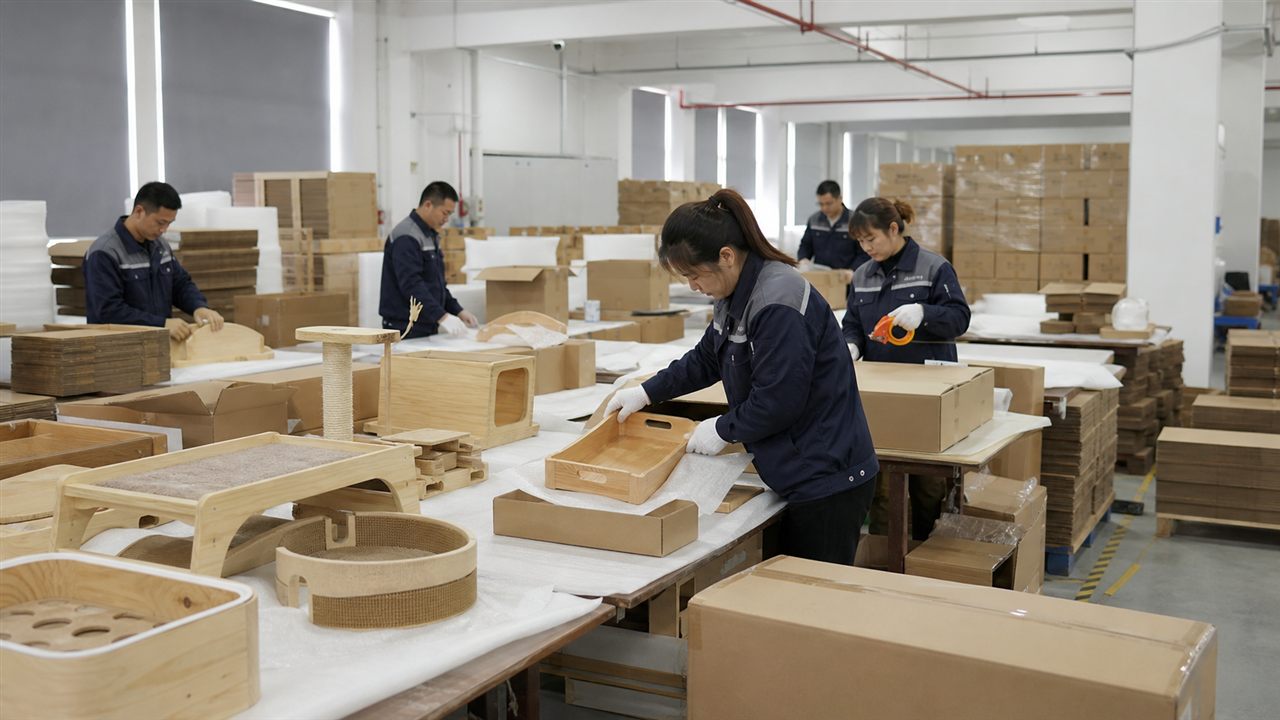
Build packaging in three levels
| Level | Purpose | Items to approve |
|---|---|---|
| Product protection | Prevent abrasion, impact, movement and part loss | Wrap, bags, tissue, corner guards, inserts and accessory containment |
| Retail or unit pack | Protect one sellable unit and communicate the brand | Box structure, graphics, barcode, instructions, warnings and sealing |
| Master carton and pallet | Support handling, stacking and export transport | Board grade, dimensions, quantity, marks, closure, pallet pattern and stretch wrap |
Protect surfaces without trapping problems
Glossy paint, dark stains and clear-coated wood can show abrasion from dust or rough packaging. Use clean separators and prevent movement. Soft tissue, foam sheet or nonwoven sleeves may be suitable depending on the finish, but materials should be checked for transfer, imprinting or reaction during storage.
Do not seal products before the coating has adequately cured. Trapped solvent odour or surface marking can create complaints even when the finish looked acceptable at packing. Agree how cure condition is verified and how long products remain open before bagging.
Control moisture and mould risk
Packaging cannot rescue wet or poorly conditioned wood. Check material moisture, factory storage and carton condition before packing. If barrier bags or desiccants are considered, select them for the route, pack volume and storage conditions rather than adding them automatically. Confirm any destination or retailer restrictions.
Cartons and inserts should also be dry. Avoid loading visibly damp cartons or leaving packed goods on wet floors. Pallets, containers and shipment schedules can expose goods to temperature changes, so the plan should consider the complete route.
Design around corners, glass and projections
Mirrors, frames, handled boxes, furniture legs and wall-mounted products concentrate impact at specific points. Keep glass or acrylic away from direct carton pressure. Use clearance and supports that transfer loads through stronger structural areas. Immobilize hardware and removable components so they cannot strike the product.
For flat-pack furniture, separate panels and protect finished faces from fasteners. Hardware bags should be sealed, identified and fixed in a position that does not cause pressure marks. Instructions should be included in the approved location.

Master-carton decisions affect freight and damage
Confirm carton outside dimensions and gross weight, quantity per carton, product orientation and closure method. A carton that is too large allows movement; one that is too tight can transfer impact directly to the product. Very heavy cartons increase manual-handling risk.
For palletized shipments, define pallet size, carton arrangement, maximum stack height, edge protection and wrap. For parcel delivery, the unit carton may face repeated drops and conveyance without pallet support. The sales channel should drive the test plan.
Labels are part of packaging quality
Approve product labels, barcode type and data, country-of-origin marks, retail artwork, carton marks and shipping labels as controlled files. Scan sample barcodes and check contrast and placement. Compare carton quantities and SKU marks with the packing list.
When multiple variants look similar, use clear SKU separation during packing. Colour, size or language variants can be physically correct but commercially wrong if placed in the wrong carton.
Test the complete pack
Use production-representative product, inserts and cartons. A hand-built sample carton can perform differently from bulk corrugated board. Testing may include drop, vibration, compression or retailer-specific protocols depending on product, route and contractual requirements. Do not claim a universal test is sufficient for every shipment.
After testing, open the pack and inspect function, joints, glass, hardware, finish, labels and accessory count. Record changes to the pack specification and repeat the relevant test after a structural change.
Pre-shipment packaging inspection
Select cartons from different stack or pallet positions. Verify pack-out sequence, protective materials, unit count, accessories, labels, carton dimensions, gross weight, marks and closure. Photograph an opened carton layer by layer so future reorders can reproduce the method.
Balance protection, cube and unpacking
Packaging also affects container utilization, parcel charges, warehouse labour and the customer’s overall unpacking experience. Reduce empty space only after confirming that the tighter pack still protects the product. Overbuilt packaging can add cost and waste without addressing the real failure point.
Ask how easily a retailer or end customer can remove the product without scratching it, losing hardware or using excessive force. Clear component order, labelled hardware and recyclable mono-material solutions may improve the pack, but only when they remain compatible with protection and destination requirements.
Buyer checklist
- List the product’s fragile and appearance-critical areas.
- Approve contact materials against the finished surface.
- Confirm coating cure before sealing.
- Define wrap, corner, insert and accessory controls.
- Approve unit box structure and artwork separately.
- Confirm master-carton dimensions, board and quantity.
- Define orientation and pallet pattern.
- Check barcode and carton-mark accuracy.
- Test a production-representative complete pack.
- Inspect products after the test.
- Record pack-out with photos and revision number.
- Verify bulk cartons before shipment.
FAQ
What packaging is best for wooden products?
The best system depends on weight, finish, fragile areas, sales channel and route. It normally combines surface protection, movement control, unit packaging and a suitable master carton.
How can importers reduce packaging damage?
Map weak points, immobilize the product, protect corners and finished faces, use production-representative cartons, test the complete pack and inspect bulk pack-out.
Should desiccant be used for every wooden product shipment?
No. Moisture control begins with conditioned products and dry storage. Barrier and desiccant decisions should match the route, pack volume, product and destination requirements.
What should be checked before container loading?
Check carton condition, quantities, marks, pallet stability, container cleanliness and dryness, loading pattern and shipment documents against the approved plan.
Who should approve retail packaging artwork?
The brand owner should approve final artwork, regulatory content and codes. The manufacturer should reproduce the controlled version and verify it during packing.
Plan packaging before the final sample
Send the product dimensions, weight, sales channel, destination and expected shipment method through the Qingtan Muyu inquiry page. For a shorter reference, use the site’s export packaging checklist.